
What Is AI in Digital Marketing?
AI in digital marketing is the use of artificial intelligence technologies such as machine learning, predictive analytics, and natural language processing to automate, analyze, and personalize marketing activities.
It helps marketers understand customer behavior, predict future actions, and deliver more relevant content at scale.
- “The global AI market is valued at approximately $391 billion.”
- “Over 4 billion mobile users use AI-powered voice search”.
Artificial intelligence has become one of the most transformative forces in digital marketing. It has changed how brands analyze data, understand customer intent, and create personalized experiences.
In the past, marketers relied on manual research and segmentation. Today, AI tools perform these tasks automatically, processing thousands of data points to reveal trends and preferences in real time.
This shift allows marketing teams to move from guesswork to data-driven actions.
AI works by collecting and interpreting behavioral signals across digital touchpoints.
Machine learning algorithms use this data to recognize patterns and make predictions, such as when a customer might buy or which message will perform best.
Natural language processing supports this by analyzing user queries, social media comments, and customer feedback to identify tone and intent.
AI & Digital Assistant Preferences in the Workplace
(in % of respondents)
Source: Workplace & Marketing AI Trends, 2025
From campaign automation to chatbots, AI now powers nearly every digital channel.
Predictive analytics helps brands forecast demand. Personalization engines deliver tailored recommendations.
Computer vision supports image-based search and product tagging.
This integration between AI and digital marketing enables three major benefits:
- Efficiency — faster execution through automation.
- Precision — improved targeting and relevance.
- Learning — systems that continuously adapt to new data.
Since 2017, the growth of big data and affordable computational power has accelerated AI adoption across marketing.
The role of AI in marketing continues to expand, combining automation, data, and creativity to help brands deliver the right message at the right time.
Next, let’s look at how AI actually works within digital marketing systems.
How AI Works in Digital Marketing
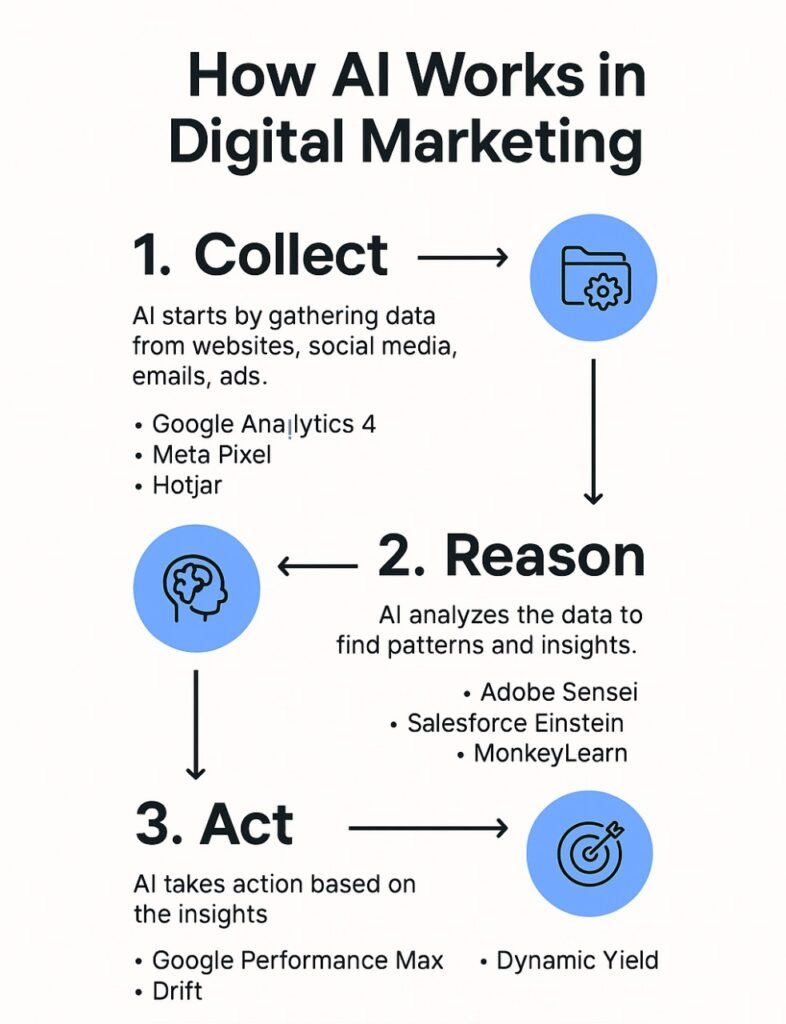
AI in digital marketing follows a simple three-step cycle: Collect → Reason → Act. This model helps brands understand customer behavior, make smart decisions, and automate actions, all in real time.
1. Collect
In the first stage, AI systems capture behavioral signals such as clicks, scrolls, purchases, and session duration across digital platforms. This data forms the foundation for real-time decision-making.
Tools that help:
- Google Analytics 4 – tracks website behavior
- Meta Pixel – tracks ad performance
- Hotjar – shows where users click and scroll
This step gives AI the raw information it needs to understand your audience better.
2. Reason
In the second stage, machine learning models analyze this data to detect recurring patterns and predict user behavior. These models refine themselves continuously through feedback and additional input.
Example uses:
- Predicting which product a user is likely to buy
- Understanding what people feel from social media comments
- Grouping similar users for targeted campaigns
Tools that help:
- Adobe Sensei – finds insights and suggests actions
- Salesforce Einstein – personalizes customer journeys
MonkeyLearn – understands text and emotions
3. ACT
In the final stage, AI tools take action. They might trigger a product recommendation, adjust an ad bid, or send a personalized email based on predicted outcomes.
Tools that help:
- Google Performance Max – automates ads across channels
- Drift – AI-powered chat for websites
- Dynamic Yield – shows personalized content and products
Natural language processing supports this pipeline by processing unstructured inputs like customer reviews, chat transcripts, and social media content. This allows systems to detect sentiment and identify intent at scale.
This data-to-decision framework replaces guesswork with responsive, evidence-based marketing.
10 Ways AI Is Used in Digital Marketing (With Renowned Tools)
Artificial intelligence enables marketers to move beyond basic automation into intelligent, adaptive marketing systems. It analyzes large-scale behavioral data, predicts outcomes, and personalizes customer journeys in real time. Here are 10 high-impact use cases with real tools trusted by enterprise teams worldwide.
1. Content Generation
AI assists in drafting blogs, product descriptions, social media posts, and ad creatives. These tools help scale output while maintaining tone and relevance.
Popular tools:
- Jasper – AI writing platform optimized for marketing copy
- Copy.ai – One-click blog outlines and brand-aligned content
HubSpot AI Content Assistant – Integrated with CRM for contextual content creation
2. Email Campaign Optimization
AI improves deliverability and engagement by analyzing historical campaign data to suggest optimal send times, subject lines, and segmentation rules.
Popular tools:
- Mailchimp AI – Predicts best send times, automates audience targeting
- ActiveCampaign – Uses machine learning for predictive email personalization
- Salesforce Marketing Cloud Einstein – Suggests content and frequency for each recipient
3. Customer Segmentation
AI-powered segmentation clusters users based on browsing behavior, lifecycle stage, purchase history, or engagement signals, improving targeting precision.
Popular tools:
- Optimove – AI clusters for CRM-based marketing automation
- Segment (Twilio) – Unifies customer data for behavioural targeting
- Adobe Real-Time CDP – Live audience segmentation across channels
4. Chatbots & Conversational AI
Chatbots powered by natural language processing (NLP) offer real-time customer support, lead capture, and product recommendations through conversational flows.
Popular tools:
- Drift – B2B AI chat for lead qualification
- Intercom – Conversational marketing with custom workflows
ChatGPT API (OpenAI) – Used for advanced custom chatbot implementations
5. Predictive Analytics
AI models forecast user actions like purchase likelihood, churn risk, or campaign success, enabling marketers to act early and allocate resources smartly.
Popular tools:
- Pega Customer Decision Hub – Predicts behavior across touchpoints
- Salesforce Einstein Analytics – Forecasts campaign outcomes
- Tableau with Einstein Discovery – Visualization paired with predictive scoring
6. Visual Recognition & AR Ads
AI identifies objects, colors, and brand assets in images or videos, allowing brands to serve shoppable AR ads or enhance product tagging.
Popular tools:
- Google Vision AI – Tagging and image understanding
- Zakeke – Visual product customization and AR
- Snap AR – Augmented reality ad experiences powered by AI
7. Dynamic Pricing
Retail and e-commerce brands use AI to adjust prices in real time, reacting to competitor moves, user behavior, or stock levels to maximize revenue.
Popular tools:
- Prisync – Competitor-based dynamic pricing
- Wiser Solutions – Repricing engine for marketplaces
- Revionics (an Aptos Company) – Predictive pricing for enterprise retailLorem ipsum dolor sit amet, consectetur adipiscing elit. Ut elit tellus, luctus nec ullamcorper mattis, pulvinar dapibus leo.
8. Ad Targeting & Retargeting
AI enhances ad performance by learning which creatives, placements, and audiences deliver the best ROI across channels.
Popular tools:
- Google Performance Max – Multichannel AI-driven ad automation
- Meta Advantage+ – AI-optimized ad placements across Facebook and Instagram
- Criteo – Predictive retargeting across display, apps, and video
9. Voice Search Optimization
AI helps brands structure content to be understood by voice assistants like Alexa, Siri, and Google Assistant, improving discoverability via conversational queries.
Popular tools:
- SEMRush Voice Search Optimization Toolkit – Keyword adaptation for voice
- Jetson AI – Voice commerce integration
- AnswerThePublic – Reveals natural question phrasing for voice optimization
10. Social Listening & Sentiment Analysis
AI scans millions of posts, reviews, and conversations to detect sentiment, emerging trends, and brand perception in real time.
Popular tools:
- Brandwatch – Enterprise-grade sentiment and trend analysis
- Sprinklr – Unified CX platform with real-time listening
- Talkwalker – Uses AI for emotion detection and predictive alerts
Benefits of AI in Digital Marketing
AI enables digital marketers to replace assumption-based campaigns with real-time decisions, improve personalization accuracy, and scale outputs without increasing human effort. These benefits impact both short-term performance metrics and long-term customer retention.
According to Mailchimp, 88% of marketers believe they must expand their use of AI and automation to keep up with customer expectations and maintain a competitive edge.
1. Higher Conversion Value from AI-Based Targeting
AI-powered platforms such as Meta Advantage+ and Google Performance Max use behavioral data to predict which users are most likely to convert. Instead of targeting based on generic demographics, these systems analyze real-time signals like engagement, scroll patterns, and click history to identify high-intent users. According to Semrush, traffic from AI-generated sources converts over four times better than traffic from traditional organic search.
2. Lower Operational Costs Through Automation
Tools like AdCreative.ai and Jasper reduce the need for manual design and content creation. By automating repetitive tasks such as A/B testing, ad variant generation, and email subject line optimization, marketing teams can execute large-scale campaigns with fewer resources. This increases output while keeping cost per acquisition under control.
3. Faster Decisions Backed by Predictive Analytics
Platforms like Salesforce Einstein and Pecan AI provide predictive insights before campaigns even go live. For example, these tools can estimate the probability of a lead converting or forecast the ROI of a specific channel mix. These data-driven predictions allow marketing managers to allocate budgets and resources with confidence.
4. Better Personalization Across All Touchpoints
AI personalization engines such as Dynamic Yield or Algolia Recommend help tailor website content, emails, and product suggestions based on each visitor’s behavior. Instead of showing static content, AI systems adapt in real time based on how users interact with previous messages. This improves session duration, engagement, and retention especially in the ecommerce and media sectors.
5. Improved Forecasting and Revenue Attribution
With platforms like Quantive or Ortto, marketers gain access to deeper attribution models. These tools connect customer journey stages across devices and channels to measure what truly drives revenue. This clarity helps teams understand which touchpoints deserve budget increases and which ones can be phased out.
Limitations and Ethical Concerns
While AI offers efficiency and scale in digital marketing, its adoption also raises important concerns. Marketers need to understand the boundaries of responsible AI use, especially when handling user data, designing algorithmic systems, or marketing AI-driven products. These risks, if ignored, can lead to compliance issues, reputational damage, and user mistrust.
Data Privacy
AI systems require large volumes of user data to operate effectively. This includes behavioral data from websites, mobile apps, CRMs, and third-party platforms. The challenge is that much of this data, especially location, browsing behavior, and purchase history is classified as sensitive under privacy regulations such as the GDPR, CCPA, and DPDP (India).
Even when anonymized, aggregated data can sometimes be reverse-engineered to identify individuals, particularly when combined across platforms. AI-powered personalization tools must therefore be implemented with explicit consent management and clear data usage policies. Regulatory scrutiny is expected to tighten as AI usage expands in marketing.
Algorithmic Bias
AI models learn from historical data but that data often reflects past human biases. This can result in skewed ad delivery, exclusion of certain audiences, or unintended discrimination. For example, automated ad placement algorithms may disproportionately prioritize certain age groups or demographics, not based on performance but on flawed training sets.
Bias is not always intentional. It often arises due to lack of diversity in datasets or improper labeling. To mitigate this, companies need to audit AI models regularly and apply fairness constraints during development.
Real-World Example: A study published in the Journal of Business Research (2022) found that algorithmic decision-making in advertising led to gender and racial skew in ad impressions, even when intent was neutral.
AI-Washing (Delphia Case)
“AI-washing” refers to the misleading practice of labeling products as “AI-powered” without substantial evidence. In April 2024, the U.S. Securities and Exchange Commission (SEC) charged Canadian fintech firm Delphia for falsely claiming its investment product used AI to deliver personalized financial strategies. The company was fined $225,000 and forced to revise all marketing claims.
Quote from the SEC:
“Delphia and Global Predictions marketed to investors that they were using AI in their investment processes when, in fact, they were not.”
SEC Release
This case marked one of the first formal actions against AI-washing in marketing and investment industries.
It has set a regulatory precedent, warning companies against overstating AI capabilities in marketing material. Marketers must ensure their messaging reflects the actual AI functionality especially in SaaS, fintech, and advertising sectors. Overhyped claims erode trust and invite legal risks.
How AI Is Changing the Marketer’s Role
AI adoption in marketing is shifting the professional focus from task execution to strategic coordination.
Instead of manually handling every part of a campaign, marketers now work alongside AI systems to:
- Interpret insights from customer data rather than manually collect and process it.
- Select tools that optimize each stage of the buyer journey, from AI writing assistants to customer behavior prediction models.
- Oversee automation of campaign elements like A/B testing, retargeting, and content scheduling.
- Refine messaging generated by AI to align with brand voice and compliance standards.
This evolution redefines the marketer as a system orchestrator, not a content factory. AI handles volume and pattern recognition; the human role ensures nuance, ethics, and business alignment.
In practice: A marketing team using AI for email segmentation can shift its focus to improving lifecycle journey mapping because the segmentation logic and data clustering are already handled.
This shift doesn’t eliminate roles. It upgrades them.Lorem ipsum dolor sit amet, consectetur adipiscing elit. Ut elit tellus, luctus nec ullamcorper mattis, pulvinar dapibus leo.
Conclusion: Understanding AI’s Role in Digital Marketing
Artificial intelligence is no longer a futuristic concept. It is a working part of modern marketing strategies, enabling faster decisions, improved targeting, and higher efficiency across channels. From analyzing customer behavior to automating personalized campaigns, AI is helping brands move from reactive to proactive marketing.
However, it is not a replacement for marketers. Instead, AI supports professionals by handling repetitive tasks, unlocking insights from data, and creating space for strategic thinking. With more than 1.8% of all US job listings now in the AI sector (Our World in Data), the demand for AI-literate marketing professionals is growing.
The key is not to fear AI but to understand how to use it responsibly and effectively. As the technology evolves, so should our approach—focused on transparency, customer value, and ethical integration.
Your competitors are already using AI. Are you?
Frequently Asked Questions
What is the 30% rule in AI?
Will AI replace marketers?
Can AI do digital marketing?
What are the best AI tools?
Is AI suitable for small businesses?
What are examples of AI in marketing?

Ermus is an SEO specialist and content writer with 2 years of experience in driving website growth through effective search strategies and engaging content. Specializing in local SEO, on-page/off-page optimization, and semantic content, she applies Koray Tuğberk GÜBÜR’s holistic SEO methods to build authority and relevance across topics. Ermus stays ahead of the curve, constantly refining strategies to adapt to evolving search trends.