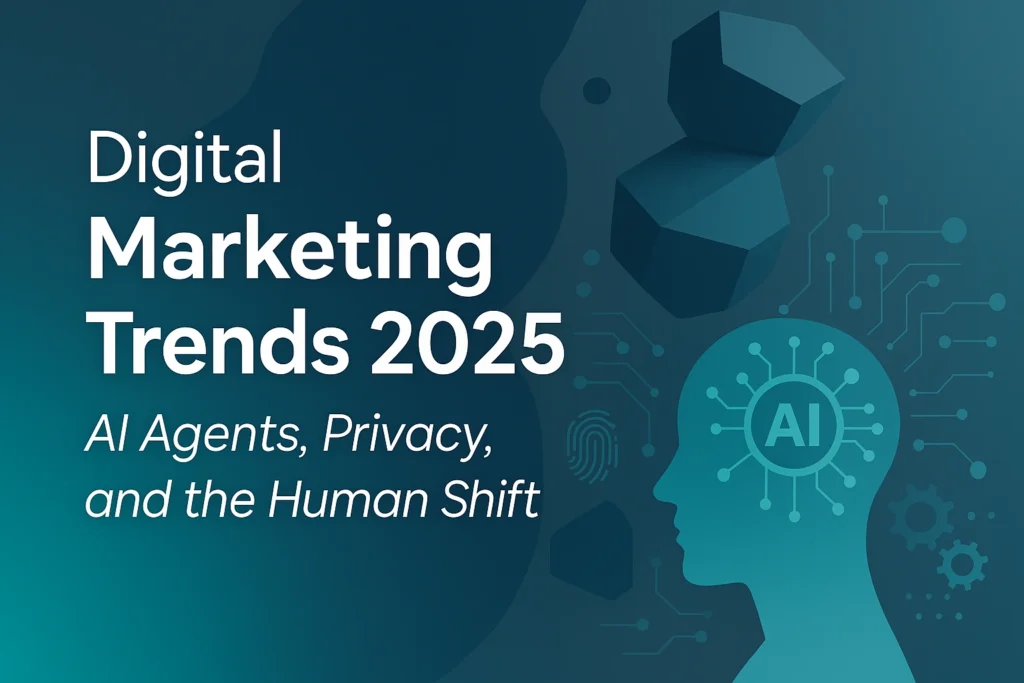
Digital marketing in 2025 is driven by smarter automation, ethical data use, and human-centered storytelling. Over 54 % of marketers now rely on AI tools, up from 37 % in 2024 (DMI ) and 53% of consumers distrust AI-powered search results.¹ But the brands that combine technology with empathy, the focus shifts from chasing clicks to earning lasting trust.
Digital marketing in 2025 feels different. The industry that once revolved around algorithms, clicks, and ad impressions now revolves around trust.
The endless chase for reach and visibility has been replaced by a quieter, smarter race for credibility, connection, and consent. Every marketer now faces the same truth: audiences aren’t impressed by frequency anymore; they’re drawn to authenticity.
AI tools run the numbers, automate the workflows, and predict what’s next. But even as technology takes on more of the heavy lifting, brands are learning that data alone doesn’t drive loyalty. Empathy does. Consumers have become experts at spotting manipulation. They know when content is written for search engines instead of humans.
That’s why the biggest marketing trend of 2025 isn’t a new platform or another AI tool. It’s the return of human relevance.
Every advancement, from predictive analytics to voice search, from shoppable videos to generative AI, now points back to one challenge: how to make technology feel personal, ethical, and real.
In this year’s landscape, the winners will be the brands that automate with care, market with integrity, and communicate like people, not systems.
The Role of AI and Automation in 2025 Marketing
In 2025, AI has quietly moved from being a supporting tool to the engine running modern marketing. What once felt like futuristic add-ons, automated reports, predictive dashboards, and smart ads have now become the everyday baseline.
Imagine this:
A mid-sized clothing brand sets up its campaigns on Meta and Google once a week. The rest is handled by its AI assistant. It studies customer behavior, adjusts budgets by time of day, rewrites ad copy for top-performing segments, and pauses low-ROI ads automatically. No big reveal. No magic. Just an invisible system that keeps learning.
This is the real face of AI in 2025. A recent SurveyMonkey report found that 88% of marketers now use AI tools in their daily work. Similarly, McKinsey’s State of AI 2025 survey revealed that nine in ten organizations have integrated AI into regular business operations. Meanwhile, 74% of marketers using AI for segmentation reported improved conversion rates (Litslink, 2025).
But the smartest marketers aren’t chasing every new platform. They’re learning where AI ends and strategy begins. Because while machines can predict clicks, they can’t understand why people click. They can’t feel the subtle tone that builds trust, the story that creates loyalty, or the emotion that turns a buyer into a fan.
The future isn’t AI versus humans. It’s about AI doing the heavy lifting so marketers can focus on meaningful thinking, combining precision with purpose.
Personalization That Feels Human
Personalization used to mean throwing someone’s first name into an email. Now it’s about something deeper: how a brand makes people feel seen without crossing the line.
As third-party cookies fade out, marketers are learning to earn data instead of renting it. First-party data has become the foundation of trust. People don’t want to be tracked; they want to be understood.
Tools like Usercentrics and advanced CRM automations make that process smoother, but they can’t replace what actually keeps customers: empathy. The tech can collect and segment, but tone and timing still decide whether someone feels connected or targeted.
And it works. According to Forbes, 94% of consumers stay loyal to brands that are transparent about how they use data. That number isn’t about privacy policies. It’s about respect. Personalization that feels human doesn’t try to impress. It tries to understand.
Social Media Is Turning Into a Community Space
The era of influencer glamour is fading. People are no longer impressed by picture-perfect ads or polished partnerships. They want something closer, smaller, and more real like conversations instead of campaigns.
Social media in 2025 isn’t a stage anymore. It’s a circle. Platforms like Threads, BlueSky, and LinkedIn are reshaping how brands connect with audiences. Instead of broadcasting to millions, the most successful brands are learning to speak meaningfully to hundreds and letting those hundreds speak for them.
On Threads, text-only posts with humor or useful insights now outperform polished visuals. On LinkedIn, employee-generated content has become one of the strongest trust signals a company can create. A short behind-the-scenes video or a post written by a team member now drives more engagement than most influencer collaborations ever did.
The reason is simple. Audiences don’t crave more content; they crave context. They want to see the people behind a logo, to hear a voice that sounds human, not rehearsed. According to the Digital Marketing Institute’s 2025 Trends Report, the most trusted brands will be those that invest in real relationships, not just reach.
Some brands are already leading that shift. REFY, for example, built loyalty not by buying followers but by nurturing a private community of dedicated fans, even hosting offline retreats for them. That kind of intimacy can’t be faked or bought. It’s earned through conversation, consistency, and care.
Employee advocacy and micro-influencers will define this new era. The next wave of social marketing is powered by the people inside your brand, not the ones hired to pretend they care about it.
Social media is no longer about who shouts the loudest. It’s about who listens best.
Let’s Talk About Your Next Move
How Is AI Changing Content Creation in 2025?
Content creation in 2025 looks very different from what it did just a year ago. Writers, editors, and marketers are now working side by side with intelligent systems that learn, adapt, and support every stage of production, from idea research to optimization.
AI tools like ChatGPT, Jasper, and Google’s NotebookLM help teams find data, refine tone, and repurpose older work. Instead of replacing creativity, these tools extend it. According to Marketing Week, more than half of marketing professionals now use AI daily, compared with only 37% the year before.
But the flood of machine-written text has changed how readers respond. Repetitive phrasing, generic insights, and zero emotional pull make audiences scroll past even the most polished articles. The real advantage now comes from knowing when to stop automating and start editing. Human emotion gives direction to data.
Refreshing existing content is where AI shows real value. Research by Neil Patel found that updating older pages can increase traffic by up to 106%. With AI analytics, teams can see which topics are losing relevance and update them before performance drops.
Search engines are also making this shift clear. Google’s focus on E-E-A-T Experience, Expertise, Authoritativeness, and Trustworthiness, means content needs real voices and real proof. AI can structure it, but human credibility makes it rank.
The future of writing belongs to people who use AI as a partner, not a crutch. Machines can outline; humans give meaning.
How Search Is Evolving Beyond Google
The way people search online is changing fast. Users no longer look for a list of ten blue links instead they expect instant answers that sound human. Platforms like Google’s AI Overviews, Bing Copilot, and Perplexity now summarize information directly on the results page, often without a single click.
This shift is forcing brands to think differently about visibility. Search engines have become curators, choosing which sources to feature in their AI summaries. To earn a place there, content needs to be clear, reliable, and genuinely useful. Authority matters more than repetition.
Voice-based queries are also shaping this new landscape. People ask full questions instead of typing short phrases, and they want answers that fit natural speech. The focus is moving from keyword targeting to understanding intent such as how people think, what they need, and how they ask for it.
A newer layer, known as Generative Engine Optimization (GEO), is redefining SEO strategy. Instead of optimizing for crawlers, marketers now optimize for comprehension. Well-structured pages, data-backed insights, and consistent entity references help AI systems understand context and cite sources accurately.
Traditional search traffic is expected to fall as users rely more on conversational results, but that doesn’t mean search is losing value. It’s evolving into something deeper, an ecosystem built on trust, context, and expertise. The brands that adapt to this mindset will still be found, even when the clicks disappear.
Why Privacy and Transparency Matter More Than Ever
Data has always been the backbone of marketing. But in 2025, how that data is collected, stored, and used is what defines a brand’s credibility. Audiences have become more aware of what happens behind the pop-ups, and they’re demanding honesty instead of hidden checkboxes.
The gradual disappearance of third-party cookies has forced companies to rebuild their strategies around first-party data. Instead of buying information, they’re earning it through consent, value exchange, and trust. It’s a slower process, but it builds stronger relationships in the long run.
Platforms like Usercentrics and other consent management systems have made transparency practical, not just performative. They allow users to control what they share and help brands prove they respect those boundaries. When customers feel safe, engagement rises naturally.
Privacy completes what personalization started, a marketing model built on permission, not persuasion. It shows that automation can be empathetic when guided by ethics. According to Forbes, 94% of consumers stay loyal to brands that are transparent about how they handle data.
Privacy isn’t a regulation problem anymore; it’s a loyalty strategy. Compliance with GDPR and similar frameworks is no longer about avoiding fines; it’s about staying relevant in a world where trust is the new currency.
The most successful marketing teams of 2025 aren’t chasing every data point. They’re building systems that listen with care, track ethically, and communicate clearly. Because when people understand how their data is used, they’re more willing to share it again.
The Rise of AI Agents in Marketing
AI agents are no longer experimental. They’re becoming quiet co-workers behind every marketing team. These systems don’t just automate tasks, they make the work simple and easier. They write, analyze, plan, and even test campaign variations based on real-time behavior.
Instead of logging into five different tools, marketers can now delegate whole workflows to one agent that connects platforms, runs updates, and reports results. What makes this trend stand out isn’t the tech itself, but how it’s changing the role of humans: less time on dashboards, more time on decisions.
Marketers are moving from managing software to managing intelligent systems that learn from every campaign. Those who know how to train, correct, and guide these agents will set the new standard for marketing efficiency.
Skills Every Digital Marketer Needs in 2025
Marketing in 2025 is less about tools and more about how you use them. AI can help you write, plan, and test, but it still needs people who understand what makes others listen, click, and trust.
Recent studies from LinkedIn and IBM show that marketers who mix tech skills with people skills are in highest demand. These are the abilities that matter most now:
1. Working With AI and Data
- Knowing how to use AI tools the right way.
- Reading data and spotting what’s actually useful.
- Using results to make better decisions, not just faster ones.
2. Understanding People
- Knowing how your audience thinks and what they care about.
- Making online experiences feel simple and human.
- Building real connections instead of just chasing clicks.
3. Handling Data and Privacy
- Collecting information the right way, with user permission.
- Respecting privacy rules like GDPR.
- Being open about how data is used.
4. Telling Clear Stories
- Turning information into messages people remember.
- Using visuals and plain words instead of noise.
- Writing for real readers, not algorithms.
5. Learning and Adapting
- Trying new tools, testing ideas, and learning from results.
- Letting feedback guide your next step.
- Staying curious instead of relying on habits.
In short, the best marketers in 2025 think like humans first and use tech second.
The tools will keep changing. The skill of understanding people won’t.
Conclusion — Where Digital Marketing Is Headed in 2025
Marketing in 2025 is becoming quieter, smarter, and more intentional. The noise is fading, replaced by strategy built on real understanding. AI runs the systems, but people still run the meaning behind them.
Every click, view, and scroll now feeds something larger: how a brand earns trust. The new goal isn’t to chase algorithms but to build relationships that outlast updates.
So as automation deepens and agents learn faster, the message stays the same: technology helps you scale, but only empathy makes you matter.
Assess Your Current Content Performance
Frequently Asked Questions
What key digital marketing trends will dominate in 2025?
How can marketers prepare for AI-driven content and automation?
Why is data privacy more important than ever in marketing?
How is search changing for marketers in 2025?
What skills should a digital marketer focus on in 2025?

Ermus is an SEO specialist and content writer with 2 years of experience in driving website growth through effective search strategies and engaging content. Specializing in local SEO, on-page/off-page optimization, and semantic content, she applies Koray Tuğberk GÜBÜR’s holistic SEO methods to build authority and relevance across topics. Ermus stays ahead of the curve, constantly refining strategies to adapt to evolving search trends.