What Is Agentic AI?
Agentic AI is a type of artificial intelligence that can set goals, make decisions, and take action without needing constant direction. It doesn’t just wait for input or follow a preset list of steps. It figures out what needs to happen, then carries it out.
These systems are made up of software agents. Each one handles a specific part of the job such as checking a database, sending a message, comparing prices, or planning a route. When combined, these agents can manage full workflows from start to finish.
Agentic AI uses large language models (LLMs) as their brain to understand what’s going on. The LLM helps the system make sense of data, pick the right tools, and decide what to do next. Not only does it react but also think ahead and adjust accordingly.
The main difference between agentic AI and older types of AI is flexibility. Traditional automation sticks to scripts. Agentic systems plan their own path. They can switch tools, skip steps, or change course when things don’t go as expected.
This approach is useful in real-world situations where things change often like supply chains, insurance claims, customer service and modern search engine optimisation strategies that rely on real-time signals..
According to a recent research survey on autonomous and collaborative agentic systems, agentic AI represents a paradigm shift from passive generative models toward dynamic, autonomous multi‑agent systems that can pursue goals and adapt in real time in enterprise applications. ResearchGate
The History of Agentic AI
The ideas behind agentic AI didn’t appear overnight. They came from years of progress in machine learning, natural language processing, and automation.
The turning point came in 2017, when researchers at Google introduced the Transformer model. This new architecture made it easier for machines to understand language and context. (Vaswani et al., 2017) It became the foundation for large language models like GPT, PaLM, and others.
These models learned how to read, write, and respond in natural language. But early on, they could only answer questions or generate content. They didn’t take action. They didn’t plan.
That changed around 2022, when developers started combining language models with tools and task logic. Projects like Auto-GPT, BabyAGI, and LangChain showed how AI could do more than talk. It could complete tasks by calling APIs, using memory, and working with real systems.
This shift turned LLMs from content generators into problem solvers. Now, instead of just replying to a prompt, AI could carry out a full task, from start to finish, with limited or no help.
Today’s agentic AI builds on that foundation. It brings together planning, reasoning, and tool use in one system. It’s the next step after generative AI, less about output, more about outcomes.
Key Capabilities of Agentic AI
Agentic AI stands apart from rule-based automation and generative AI by combining decision-making, tool usage, and real-time adaptability in one system. Below are the foundational capabilities that define agentic AI systems.
Autonomous Goal Planning
Agentic systems begin with a high-level objective and deconstruct it into smaller, actionable steps. These subtasks are not pre-coded, the system dynamically decides the best approach based on available tools, current conditions, and prior outcomes.
- Translates user intent into structured workflows
- Selects tools and functions contextually
- Adjusts plans when goals shift or conditions change
It works like a smart worker who can manage a project without asking what to do next.
Reasoning and Context Awareness
Built on top of large language models (LLMs) and memory frameworks, Agentic AI understands what’s happening, not just what you said.
- It knows the bigger picture, not just one command
- Remembers what already happened in the task
- Reacts based on what’s going on right now
It doesn’t follow blindly, it thinks before it acts.
Action Execution and Feedback Loops
Agentic AI does not rely on human-triggered actions. Once it forms a plan, it can execute it directly by interacting with APIs, databases, user interfaces, software systems, or communication systems, a model increasingly used in automated email workflows and customer lifecycle campaigns.
- Initiates and manages end-to-end workflows
- Handles branching logic and conditional operations
- Uses output signals to assess success or failure
Over time, feedback from these actions feeds into learning systems, allowing agents to improve decision quality and execution efficiency.
Real-Time Adaptability
One of the defining characteristics of agentic AI is its ability to adapt mid-execution.
- If something breaks or slows down, agentic AI doesn’t freeze.
- It finds another way to finish the task
- Modifies logic paths without reprogramming
- Waits or skips steps if needed
- Keeps working without needing help
This flexibility is critical in live enterprise environments, where rigid process automation often doesn’t always go as planned.
Benefits of Agentic AI
Agentic AI moves automation beyond fixed rules and scripted flows. These systems take initiative. They plan actions, make decisions, and adjust as conditions change. This makes them far more effective in real enterprise environments where work rarely follows a straight line.
1. Handles Complex, End-to-End Workflows
Agentic AI manages entire processes, not isolated tasks. It works across ERP systems, CRM platforms, RPA tools, and internal APIs to move work from start to finish. It fits naturally into multi-step operations like insurance claims, order fulfilment, and exception handling without constant human input.
2. Reduces Manual Decision Bottlenecks
Agents analyse live data, select the right tools, and act in real time. This removes delays caused by waiting for human decisions in fast-moving areas such as logistics, customer support, and fraud monitoring. Teams see faster outcomes with less operational friction.
3. Adapts Without Rewriting Logic
Traditional automation breaks when workflows change. Agentic AI adjusts on its own. It reroutes tasks, switches tools, or changes steps when conditions shift, without requiring engineers to rewrite code. This flexibility lowers maintenance effort and speeds up change.
4. Expands Automation Coverage
Many business processes resist rule-based automation because they vary too much or rely on judgment. Agentic AI handles this complexity. It extends automation into areas like claims triage, dynamic pricing, and context-aware customer interactions that were previously manual.
5. Frees Up Human Expertise
By taking over repetitive and judgment-heavy work, agentic systems reduce low-value effort for human teams. Employees spend more time on strategy, creativity, and relationship-driven work instead of monitoring workflows or resolving routine issues, which is especially valuable in social media management where timing and relevance matter.
6. Learns and Improves Over Time
Agentic systems remember past actions and outcomes. They use that experience to refine future decisions. As usage grows, performance improves. Unlike static rules, these systems evolve without constant rewrites.
Agentic AI delivers value because it works the way real businesses work: complex, dynamic, and always changing.
How Agentic AI Works: Step-by-Step Architecture
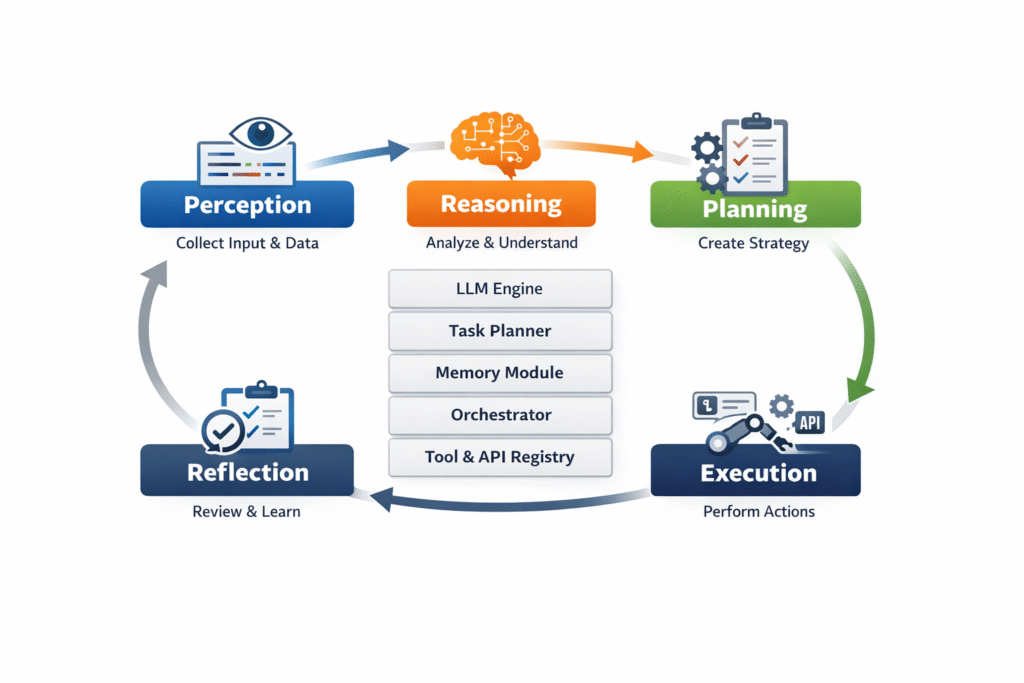
Agentic AI systems run like autonomous machines. They can understand context, create plans, take action, and improve with experience. But how does that actually happen behind the scenes?
Let’s break down the architecture into its core components and walk through how the system flows from input to action repeatedly.
Core Components of Agentic AI
Every agentic system runs on a set of moving parts. These components work together to help the agent make sense of the world, make decisions, and carry out complex tasks without constant human input.
1. LLM Engine
At the heart of the system is a large language model (LLM). This is what allows the agent to understand commands, interpret information, and reason through problems. It’s not just for generating text, it’s the thinking engine that connects the rest of the system.
2. Task Planner
Once the LLM understands what needs to be done, the planner kicks in. It breaks big goals into smaller steps. It decides which task should happen first, which tools to use, and what success looks like.
Think of it like a project manager who creates a custom plan each time based on the current situation rather than following a template.
3. Memory & State Module
This part helps the system remember. It tracks what’s already been done, stores results from previous actions, and keeps context from step to step. Without memory, the AI would start fresh every time and that wouldn’t work in real-world systems.
Short-term memory helps the agent complete a task. Long-term memory helps it get better at that task over time.
4. Orchestrator
The orchestrator runs the show. It makes sure every step happens in the right order. If something goes wrong, it decides what to do next. It’s responsible for managing retries, exceptions, timeouts, or switching paths if needed.
You can think of this as the conductor in an orchestra who doesn’t play the instruments, but it controls when and how everything happens.
5. Tool/Function Registry
No agent can do everything by itself. This registry acts like a toolbox, a list of what actions the system is allowed to take. That might include:
- APIs it can call
- Databases it can query
- Functions it can run
- Interfaces it can interact with
Each tool is described in plain language so the LLM can understand when to use it. This is how the system moves beyond just thinking and actually does the work.
Execution Flow: From Input to Action
Now that we’ve covered the components, here’s how the system flows, step by step, in a real use case. This loop runs continuously, with each step feeding into the next.
1. Perception
The system starts by collecting input. This could be a user message, a change in system data, an external trigger like a webhook, or a sensor reading.
At this stage, the AI doesn’t act. It listens, reads, or observes.
2. Reasoning
Next, the LLM analyzes the input and applies context.
- What’s the user asking for?
- What’s already happened?
- What matters in this situation?
This step is about understanding the “why” behind the request.
3. Planning
The planner maps out a path to the goal. It selects from available tools, chooses the right order, and creates a plan that fits the situation.
Unlike rule-based systems, this plan isn’t hardcoded. It’s created on the fly based on the problem.
4. Execution
Once the plan is in place, the AI acts. It runs code, calls APIs, moves data, sends messages, whatever the plan requires.
Each action is tracked. If something fails, the orchestrator decides whether to retry, skip, or re-plan.
5. Reflection
After the task is complete (or partially complete), the AI reflects on what happened.
- Was the action successful?
- Did the outcome match the goal?
- What can be improved next time?
This feedback helps the system improve over time, especially when combined with reinforcement learning or human review.
Agentic AI vs Other Types of AI
To understand what makes it different, we need to compare it with the three closest categories of AI technologies:
- generative AI,
- autonomous systems,
- and traditional automation.
Each of these systems plays a different role. What sets agentic AI apart is its ability to combine decision-making, planning, execution, and learning in a single loop. I
t doesn’t wait for instructions. It doesn’t follow scripts. It identifies a goal, plans how to reach it, uses external tools, and adapts based on outcomes.
Agentic AI moves beyond response-based systems by coordinating steps, using tools, and reaching defined goals on its own..
Agentic AI vs Generative AI
Generative AI is trained to create. It responds to prompts by producing text, images, or code based on patterns it has seen in its training data. It’s useful for drafting emails, designing visuals, writing code snippets, or answering questions. However, once the content is generated, it stops. It doesn’t know what to do with that output.
Agentic AI begins where generative AI ends. It can take generated content and use it to complete tasks. For example, a generative model might write a marketing email. An agentic system can write that email, run an A/B test, collect engagement metrics, adjust the strategy, and schedule follow-ups.
This difference makes agentic AI suitable for dynamic workflows that require interaction, coordination, and goal completion.
| Feature | Generative AI | Agentic AI |
|---|---|---|
| Content creation | Yes | Yes |
| Action execution | No | Yes |
| Goal planning | No | Yes |
| External tool use | Limited | Full |
| Autonomy | Requires prompting | Operates independently |
Agentic AI vs Autonomous Systems
Autonomous systems are not new. They exist in robotics, automotive systems, and IoT environments. What they share is a rules-based framework. These systems are designed to react to inputs using pre-coded responses. A robot vacuum, for example, changes direction when it hits a wall. A car’s braking system responds to sensor input.
The difference is in flexibility. Traditional autonomous systems follow a static decision tree. They don’t plan beyond what’s been coded into them.
Agentic AI doesn’t rely on fixed scripts. It uses memory, feedback, and task planning to decide what to do next. It can look ahead, weigh different outcomes, and course-correct in real time. It doesn’t just react to the environment. It interprets the environment and redefines the next steps based on context.
This makes agentic AI capable of handling complex, unpredictable environments — something rigid autonomous systems are not built for.
Agentic AI vs Traditional Automation (RPA)
Robotic Process Automation (RPA) was designed for consistency. It automates rule-based, repetitive tasks like data entry, form filling, or report generation. These bots follow set workflows, and they do not deviate unless updated manually.
Agentic AI introduces variability and reasoning into automation. It doesn’t need a fixed path to complete a task. It selects actions based on real-time context and changing conditions. If an exception occurs, it doesn’t fail or escalate. It adapts.
While RPA is ideal for structured, predictable tasks, agentic AI excels in complex workflows where variables are unknown or constantly changing. Rather than replacing RPA, it builds on it. In many systems, agentic AI works alongside bots, handling logic, context, and decisions while RPA executes the mechanical steps.
| Feature | RPA | Agentic AI |
|---|---|---|
| Follows fixed rules | Yes | No |
| Works in structured data | Yes | Yes |
| Handles ambiguity | No | Yes |
| Learns from feedback | No | Yes |
| Adapts workflows | No | Yes |
Unlike generative AI, autonomous systems, or RPA, agentic AI combines creation, reaction, and automation all by itself.
Agentic AI in the Enterprise: Key Use Cases
Agentic AI is not made for small, isolated tasks. It is built to operate inside large organisations where data, systems, and decisions are spread across tools like ERP platforms, CRM systems, APIs, and automation software. These systems do more than follow instructions. They understand goals, decide what to do next, and adjust their actions as conditions change.
Below are the areas where this approach delivers the most value.
Insurance Claims
Agentic AI shortens the claims process by checking claim details, collecting information from internal systems, and keeping customers updated in real time. While basic automation tools can submit forms or move data, the AI agent manages the entire process from start to finish. This reduces manual work and allows claims teams to focus on exceptions instead of routine cases.
Logistics and Supply Chain
In logistics, delays quickly turn into losses. Agentic AI helps by planning delivery routes, predicting demand, and responding to disruptions as they happen. By working directly with live ERP data, it can reroute shipments or adjust inventory levels during operations rather than reacting after problems occur.
Finance
In finance, timing matters. Agentic AI continuously tracks market conditions, adjusts portfolios, and highlights new risks as they emerge. It connects with financial platforms and internal risk systems to support fast decisions, while still keeping clear records for review and compliance.
Drug Discovery
In pharmaceutical research, agentic AI helps reduce long development cycles. It analyses research papers, clinical data, and regulatory information to suggest promising drug targets and suitable trials. If an approach does not work, the system can explore alternatives instead of stopping at a predefined path.
Healthcare
In healthcare operations, administrative work and documentation take a significant amount of clinicians’ time, with data showing that for every hour spent face-to-face with patients, doctors spend roughly two additional hours on administrative tasks such as documentation, billing, and compliance reporting.
This burden contributes to burnout and workflow inefficiencies, creating an opportunity for agentic AI systems to automate coordination work and routine processes, freeing clinical and administrative staff to focus on patient care and higher-value activities.
Customer Support
When connected to CRM systems, agentic AI can manage support requests from the moment they arrive. It understands customer intent, uses past interactions to guide responses, and escalates only when human support is needed. In many cases, it can resolve issues before they grow into formal complaints.
Software Testing
Agentic AI supports quality assurance by creating and updating test cases as software changes. Rather than relying on fixed scripts, it decides which areas need testing based on recent updates and risk. Integrated into CI/CD pipelines, it helps teams maintain software quality without slowing development.
In short, agentic AI fits where work is complex, fast-moving, and interconnected. It brings structure and decision-making into processes that traditional automation struggles to handle.
Orchestration vs. Choreography in Agentic AI
In Agentic AI systems multiple agents, tools, and services work together in live environments. Two coordination models define this interaction: orchestration and choreography.
Orchestration: Centralised Control
Orchestration relies on a central decision layer that assigns tasks, sets the order of execution, and monitors outcomes. One system decides what happens next and ensures every step follows a defined sequence.
This approach works best for high-risk or regulated processes where order and predictability matter, such as insurance claims, financial transactions, or compliance workflows. It is commonly used when agentic AI connects with ERP systems, RPA tools, or workflows that cannot tolerate deviations.
Choreography: Distributed Autonomy
Choreography removes the central controller and allows agents to act independently based on events and conditions. Each agent responds to signals in the system and takes action when relevant, without waiting for direct instructions.
This model suits fast-changing environments like supply chains, customer support routing, or fraud detection, where speed and adaptability are more important than strict sequencing. It also scales well across microservices and distributed architectures.
In practice, enterprise agentic systems often use both. A customer order may follow an orchestrated flow, while inventory changes or delivery issues trigger choreographed responses across connected systems.
Risks and Challenges of Agentic AI
Agentic AI is powerful but it also comes with high-stakes risks that need clear boundaries and strong governance. These aren’t the usual automation issues. They’re deeper, system-level challenges that demand discipline.
Human Oversight vs. AI Autonomy
Agentic systems act without constant instruction. That’s the appeal and at the same time its the risk. When decisions involve ethics, safety, or judgment, people need to stay involved. Without clear human checkpoints, agents may act in ways that are valid technically, but wrong in context.
Rushing from Prototype to Production
Teams often move too fast. They test agentic AI in demos, get excited by early results, and push it live. But real-world systems are messier. Without full testing, profiling, and safeguards, agents can break under real workloads causing silent failures that are hard to catch.
Fragile System Dependencies
Agentic systems rely on many moving parts: LLMs, tools, APIs, orchestration layers. One update can break another. If you don’t manage versions tightly or test deeply, you’ll ship brittle systems that crash or misbehave with every small change.
Ambiguous Instructions
Agents rely on language. If you describe a tool poorly or give unclear goals, the agent may act in unexpected ways. It won’t ask for clarity, it’ll act. And sometimes, it’ll be wrong. Every function, tool, and task must be defined clearly in plain language.
Lack of Transparency
If an agent made a mistake, can you explain why? Without full logging and traceability, you’ll struggle to answer that. Enterprises can’t afford black-box decisions. Every step like input, action, output must be auditable. Trust depends on it.
Agentic AI works but only with guardrails. If you skip testing, versioning, or oversight, you invite silent failure. If you manage it like real software, with clear roles and system design, it delivers real value.
Best Practices for Agentic AI Implementation
Deploying agentic AI is not about making agents run once. It is about making them run safely, consistently, and at scale in real production environments. The practices below focus on control, reliability, and long-term stability.
Systems Design and Architecture
Design agentic systems as modular units. Separate memory, planning, execution, reasoning, and logging into clear components. Keep these parts loosely connected so one change does not break the whole system. Use clean, testable interfaces so teams can isolate and fix issues early.
Human-in-the-Loop Controls
Keep humans involved where judgment matters. Do not allow agents to operate in closed loops without review. Use human checkpoints to approve sensitive actions, handle unclear situations, and enforce ethical or business rules when needed.
Testing Protocols
Do not rely only on basic tests. Agentic systems require broader testing coverage:
- Test prompts to confirm instructions lead to correct actions
- Test functions to verify outputs are accurate
- Test failure paths to ensure agents stop safely when inputs go wrong
Build a test matrix that includes normal behavior and edge cases.
Profiling and Optimization
Measure how agents use tokens, tools, and time during real workloads. Track execution paths and decision patterns. Use this data to reduce latency, control costs, and prevent waste, especially when running on paid model APIs.
Framework Selection
Choose a framework that is stable and well documented. Platforms with strong community or enterprise backing reduce long-term risk. Avoid building custom frameworks unless the problem truly requires it, as custom systems increase maintenance effort and slow delivery.
Strong agentic systems succeed because teams design them with discipline, not because the technology looks impressive.
Business Benefits of Agentic AI
Agentic AI delivers practical value by solving real bottlenecks that traditional automation cannot handle.
Efficiency
It automates full decision chains, not just single tasks. This reduces wait times caused by manual reviews or handoffs.
Customer Experience
It runs in context. Customers get faster, more relevant responses without being pushed through fixed steps.
Human Augmentation
It supports teams by handling routine work. People stay focused on strategy, edge cases, and higher-value decisions.
Operational Adaptability
When systems or conditions change, the agent adapts. No need to update logic or workflows manually.
Scalability
Agents can run across systems and regions. Businesses grow without increasing overhead or adding new staff for every process.
The Future of Agentic AI
Agentic AI is a key step toward more general machine intelligence. Its ability to plan, act, and learn in dynamic environments points to a future where AI systems handle more complex workflows with less oversight.
Expect growth in three areas:
- Orchestration platforms: More robust frameworks will emerge to manage multi-agent ecosystems.
- Enterprise adoption: Businesses will shift from static automation to dynamic agents across departments.
- Governance and regulation: New controls will define how autonomous systems operate safely and transparently.
Conclusion: Why Agentic AI Matters Now
Agentic AI is not a trend label. It marks a real change in how software behaves.
Traditional systems wait for instructions. Agentic systems observe context, decide what to do next, and carry work through to completion with minimal intervention. That shift changes how organisations run day-to-day operations.
For enterprises, the impact is practical and immediate. Teams move faster. Processes break less often. Operations adapt as conditions change instead of stalling or escalating every decision to humans. Systems scale without adding layers of manual control.
Adoption, however, requires discipline. Organisations need clear design, strong testing, governance, and defined human oversight. Agentic AI works best when companies treat it as operational infrastructure, not a plug-and-play feature.
When implemented correctly, the results speak for themselves. Fewer bottlenecks. Better customer experiences. Teams that spend time on judgment, strategy, and relationships instead of process management.
Agentic AI matters now because software no longer just supports work. It does the work. Businesses that apply agentic AI principles correctly are already reshaping how digital marketing strategies are planned, executed, and scaled.