What Is Digital Marketing?
Digital marketing refers to the use of online marketing platforms, data analytics, and technology-driven tools to promote products and services. Digital marketing strategies such as SEO, PPC, and email marketing work together to build a consistent online presence.
Unlike traditional advertising, it empowers businesses to reach global audiences, measure campaign performance, and personalize user experiences in real time.
Whether you’re a startup or an established enterprise, digital marketing enables growth through data-backed strategies and scalable communication channels.
10 Key Benefits of Digital Marketing (Quick Overview)
Before diving into the detailed sections, here’s a snapshot of the 10 most important benefits that businesses gain through digital marketing:
- Global Reach: Connect with audiences across countries and regions instantly.
- Cost-Effectiveness: Maximize ROI with lower campaign costs compared to traditional media.
- Measurable Results: Track performance using real-time analytics.
- Targeting & Personalization: Deliver tailored content based on user behavior and demographics.
- Flexibility & Adaptability: Adjust campaigns instantly based on results.
- Enhanced Engagement: Build meaningful customer relationships through interactive channels.
- Improved Conversion Rates: Turn visitors into leads with optimized funnels.
- Data-Driven Decision Making: Leverage analytics to refine marketing strategies.
- Stronger Brand Credibility: Boost brand authority through consistent digital presence.
- Sustainable Growth & Competitive Edge: Combine data, automation, and creativity for long-term success.
Each of these benefits plays a crucial role in shaping the business impact of digital marketing. Let’s explore them in depth.
1. Global Reach
Digital marketing breaks down geographic barriers, allowing brands to reach international markets without physical presence. Through SEO, social media, and paid advertising, businesses can appear in front of audiences worldwide within hours of launching a campaign.
For example, a small eCommerce brand in Pakistan can sell to U.K. customers using Google Ads and global shipping integrations, something traditional marketing could never achieve cost-effectively.
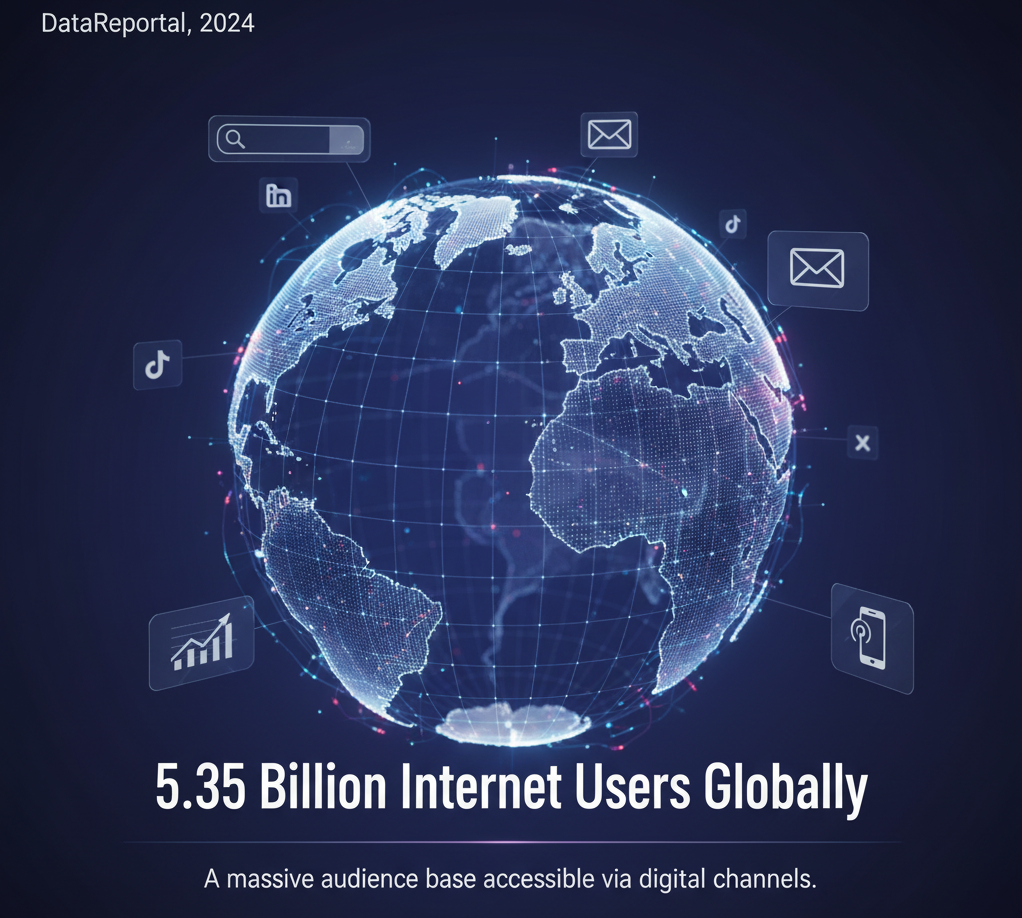
According to DataReportal’s Digital 2024 report, there are over 5.35 billion internet users globally, representing a massive audience base accessible via digital channels.
Pro Tip:
Use multilingual SEO and local domain targeting (like “.co.uk” or “.de”) to improve visibility in country-specific search results and boost global conversions.
2. Cost-Effectiveness
Compared to print, TV, or billboard advertising, digital marketing delivers far better returns on a lower budget. Small and medium-sized enterprises (SMEs) particularly benefit because digital ads can be scaled and targeted precisely.
Platforms such as Google Ads and Meta Ads Manager allow you to set daily budgets, pause underperforming campaigns, and measure every dollar spent.
The global digital advertising market is projected to reach over $667 billion in 2024, underscoring the shift away from costly traditional media.
Pro Tip:
Start with remarketing campaigns; they target users already interested in your brand, often yielding a 200% higher ROI than first-touch campaigns.
3. Measurable Results
Unlike traditional marketing, digital campaigns can be tracked with precision. Metrics such as click-through rate (CTR), conversion rate, and cost per acquisition (CPA) provide a clear view of performance.
Tools like Google Analytics 4, Adobe Analytics, and HubSpot CRM let marketers measure engagement and optimize campaigns in real time. According to Salesforce, 2024, 88% of top marketers rely on analytics to drive decision-making.
Companies using advanced analytics report 5–8% higher marketing ROI than those relying on intuition alone.
Pro Tip:
Set up UTM tracking on all paid and organic campaigns to analyze which platforms and creatives generate the highest ROI.
Need help setting up GA4 or dashboards for better marketing insights?
4. Targeting & Personalization
Digital marketing enables hyper‑targeted campaigns that deliver the right message to the right audience. Using customer data from analytics platforms, businesses can segment users by demographics, interests, or behavior and serve personalized ads or content. AI‑driven tools like Google Performance Max and Meta Advantage+ use machine learning to predict user intent and optimize conversions. In addition, social listening tools (e.g., Sprout Social, Brandwatch) help brands monitor online conversations, understand sentiment, and refine audience segments in real time.
AI-driven tools like Google Performance Max and Meta Advantage+ use machine learning to predict user intent, improving conversion rates.
Personalization can increase revenues by 5–15% and improve ROI by 10–30%.
Pro Tip:
Combine email automation with behavior-based segmentation to deliver customized product recommendations — increasing repeat purchases and loyalty.
5. Flexibility & Adaptability
In digital marketing, campaigns can be adjusted instantly based on performance data. Whether it’s tweaking ad copy, shifting budgets, or updating creative assets, brands can optimize their approach in real time.
A/B testing tools like Google Optimize, Optimizely, or VWO allow marketers to compare variations and refine user experience continuously. This flexibility keeps campaigns relevant amid changing trends or audience preferences.
Marketers who embrace agile practices outperform traditional marketing teams in conversion efficiency and ROI.
Pro Tip:
Adopt a “test-learn-scale” approach such as run small-budget tests first, then scale only the best-performing campaigns to reduce waste and improve ROI.
6. Enhanced Customer Engagement
Digital marketing thrives on two-way communication, something traditional marketing rarely achieved. Platforms like Instagram, LinkedIn, and TikTok allow brands to directly interact with users, respond to comments, and build authentic connections.
Engagement drives trust and brand recall. According to Emarsys & Forrester, 62% of customer-obsessed businesses say their omnichannel engagement strategy leads to higher margins. Meanwhile, 66% of consumers say they will abandon a brand if they don’t receive personalized experiences.
Engagement tactics such as polls, contests, interactive videos, and user-generated content (UGC) strengthen the community and make customers feel valued.
Pro Tip:
Encourage UGC by featuring your customers on brand pages or newsletters because user content is 2x more likely to convert than brand-generated posts.
Improved Conversion Rates
Conversion rate refers to how many users perform a desired action such as filling a form, making a purchase, or subscribing to a newsletter.
Digital marketing offers multiple optimization tools like Google Ads, Hotjar, and CRO platforms that track on-site behavior and identify friction points.
According to Ruler Analytics, the average website conversion rate across industries is 2.9%, while Unbounce reports that high-performing landing pages average around 6.6%.
Source: Ruler Analytics, 2025
Source: Unbounce, 2024
Pro Tip:
Combine A/B testing + heatmaps + retargeting which is a trio proven to lift conversion rates by up to 300% for eCommerce brands.
8. Data-Driven Decision Making
Data is the backbone of digital marketing success. Instead of relying on guesswork or intuition, businesses can now make strategic decisions backed by real-time metrics and historical patterns.
Advanced analytics tools such as Google Analytics 4, Tableau, Power BI, and HubSpot CRM enable marketers to track key performance indicators (KPIs) like traffic sources, user engagement, bounce rates, and campaign ROI across every touchpoint in the customer journey.
By analyzing this data, businesses can:
- Identify which channels drive the most qualified traffic
- Understand customer behavior across devices and platforms
- Pinpoint friction points that reduce conversions
- Refine content and ad strategies for better performance
This enables evidence-based decision-making. According to Deloitte via CTO Magazine, data-driven companies are 23x more likely to acquire customers and 6x more likely to retain them.
Pro Tip:
Build a centralized marketing dashboard that integrates all platforms (SEO, PPC, social, CRM), enabling real-time visibility and faster course correction.
9. Stronger Brand Credibility
Digital marketing enables transparency, authority, and consistency which is crucial for brand credibility. A business that appears in top search results, publishes expert content, and actively engages audiences gains greater trust.
86% of customers say they’re willing to pay more for a great customer experience, highlighting how brand presentation directly influences perceived value.
Source: Emarsys / SuperOffice, 2024
Consistent blogging, testimonials, and data-backed case studies help position a brand as an industry leader.
Pro Tip:
Create thought leadership content (whitepapers, research reports, webinars) to strengthen brand authority and earn backlinks from reputable domains.
10. Sustainable Growth & Competitive Edge
Digital marketing provides a scalable, repeatable framework for long-term growth. As campaigns mature, businesses collect data that continually improves performance — making future strategies smarter and more cost-efficient.
Automation, AI, and real-time analytics shorten feedback loops, allowing businesses to respond faster to market changes than competitors still relying on traditional models.
According to Firework, businesses using marketing automation report a 14.5% increase in sales productivity and 12.2% reduction in marketing overhead. The global marketing automation market is expected to more than double by 2030.
Pro Tip:
Focus on integrated marketing ecosystems by combining your email, social, and paid channels under one analytics framework to ensure consistent user journeys and sustainable results.
Business Impact of Digital Marketing
The cumulative effect of all these benefits directly translates to tangible business growth
| Business Metric | Impact from Digital Marketing | Source / Notes |
|---|---|---|
| ROI | For every dollar spent on marketing automation, companies see an average ROI of $5.44 (a $5.44 return per $1 invested) over the first three years. | The CMO |
| Lead Generation | Companies using marketing automation report a 451% increase in qualified leads. | Firework |
| Customer Retention | Marketing automation can lead to a 12.2% reduction in marketing overhead while boosting productivity. | WinSavvy |
| Cost Efficiency | The global marketing automation market is projected to more than double from approximately $6.6 billion in 2024 to $13–15 billion by 2030 — showing scale, efficiency gains, and market confidence. | Cropink |
This table highlights how digital marketing’s measurable, adaptable, and data-driven approach fuels sustainable business performance across industries.
The Role of AI, Automation & Personalization in Scaling Digital Marketing Benefits
AI and automation are reshaping how businesses drive results from digital marketing. These technologies enhance key functions such as targeting, segmentation, campaign delivery, and performance measurement.
Platforms like ChatGPT, Google Performance Max, and Salesforce Einstein are widely used to generate content, personalize ads, and analyze user behavior at scale. However, the most impactful results occur when AI is integrated into Customer Relationship Management (CRM) systems.
A peer-reviewed study published in ScienceDirect (2025) found that AI-enabled CRM systems improve every stage of the customer lifecycle, from acquisition to retention. The result is more accurate targeting, stronger customer relationships, and higher overall marketing efficiency.
1. Personalization That Connects
AI systems use customer data and behavior signals to personalize content in real time. This includes email campaigns, product recommendations, and website experiences. Personalized emails, for example, can generate up to 41% higher click-through rates.
Source: Instapage, 2024
The ScienceDirect study emphasizes that effective personalization relies on unified customer data. Without aligning data from marketing, sales, and service channels, brands risk delivering inconsistent experiences.
Pro Tip:
Use your CRM as a central hub for customer data. Connect it with your AI tools to deliver consistent personalization across email, website, and social media.
2. Automation That Reduces Cost and Saves Time
Automation reduces manual work such as scheduling messages, qualifying leads, or managing ad budgets. This increases efficiency while lowering overhead.
Companies using marketing automation report a 14.5% increase in productivity and a 12.2% reduction in marketing costs.
Source: Firework, 2025
The ScienceDirect study found that CRM automation also helps reduce lead response times, improves customer service resolution rates, and flags users at risk of churn.
Pro Tip:
Start with automating simple workflows, such as welcome emails or follow-ups. Then expand to multi-step journeys that involve other teams like support or sales.
3. Insight-Driven Optimization
AI tools help marketers make faster and more informed decisions. Platforms like Google Analytics 4, Tableau, and AI-native CRMs process large volumes of structured and unstructured data. These insights show which campaigns are performing well and where improvements are needed.
A 2025 TechRadar report shows that 93% of CMOs are seeing a positive return on investment from generative AI in marketing.
Source: TechRadar, 2025
The ScienceDirect research adds that success depends on having a clear AI strategy. High-performing companies define objectives, involve multiple departments, and implement responsible data practices early in the process.
Pro Tip:
Create a checklist for all AI projects. This should include defined goals, data governance policies, KPIs, and ethical standards for transparency and fairness.
Case Study: SEO-Driven Business Growth
Company: Canva
Objective: Improve global visibility and reduce paid advertising dependency.
Strategy: Canva focused on SEO-driven content marketing, creating educational blogs, templates, and tutorials optimized for search intent.
Results:
- Achieved 75M+ organic visitors per month (Ahrefs, 2024)
- Reduced paid ad spend by 40%
- Strengthened domain authority through 50,000+ backlinks
Conclusion: Understanding the Benefits and Business Impact of Digital Marketing
Digital marketing offers more than visibility. It enables real-time adaptation, measurable performance, and deeper customer engagement through personalized experiences.
From startups to global brands, it provides scalable, cost-effective strategies that support long-term business growth.
When businesses apply these core benefits strategically and integrate technologies like AI and automation, they can increase efficiency, boost return on investment, and maintain a competitive edge in today’s digital-first environment.
Build Your Digital Marketing Strategy Today
Frequently Asked Questions
Q1. What is the biggest benefit of digital marketing?
Q2. How does digital marketing help small businesses?
Q3. Which digital marketing channel offers the best ROI?
Q4. Is AI replacing human marketers?

Ermus is an SEO specialist and content writer with 2 years of experience in driving website growth through effective search strategies and engaging content. Specializing in local SEO, on-page/off-page optimization, and semantic content, she applies Koray Tuğberk GÜBÜR’s holistic SEO methods to build authority and relevance across topics. Ermus stays ahead of the curve, constantly refining strategies to adapt to evolving search trends.