
How to Build, Optimize, and Scale Multilingual Websites for Global Search
Search engines no longer show the same results to every user.
A person searching in the UK sees different pages than someone searching in France, Germany, or Australia. Language, location, currency, and local intent now shape what appears on the first page.
In 2026, this gap is wider than ever. AI Overviews, regional SERPs, and localized ranking systems reward websites that understand users by country and language. Websites that ignore localization lose visibility, even with strong content.
This is where international SEO becomes essential.
International SEO helps businesses expand beyond one market. It ensures the right users see the right version of a website at the right time.
Here you will understand how international SEO works, how to implement it correctly, and how to scale it without losing rankings, traffic, or revenue.
It follows a step-by-step system used by global SaaS companies, eCommerce brands, and publishers.
What Is International SEO?
Search engines do not rank websites in the same way for every user.
A person searching from the United States, Germany, or Japan will often see different results for the same query. Language, location, currency, and local intent all influence what appears on the first page.
International SEO exists to manage this difference.
International SEO is the process of optimizing a website so that it ranks correctly in different countries and languages. It helps search engines understand which version of a page should be shown to which audience.
Instead of serving one generic page to everyone, international SEO allows a website to deliver content that matches the user’s region, language, and expectations.
When this system works properly, users find relevant content faster, trust the website more, and convert at higher rates.
How International SEO Works
International SEO works by combining three main systems.
First, it uses technical signals to communicate geographic and language targeting. These include URL structures, hreflang tags, canonical tags, and language attributes.
Second, it uses localized content to match regional search intent. This means adapting vocabulary, pricing, examples, and tone to each market.
Third, it builds regional authority through backlinks, brand mentions, and user engagement from target countries.
Search engines evaluate all three together.
If one layer is weak, performance drops.
Strong content without technical clarity confuses crawlers.
Perfect technical setup without localization fails to convert.
Localized pages without authority struggle to rank.
International SEO succeeds only when all layers align.
International SEO vs Global SEO vs Multilingual SEO
Many websites fail internationally because they misunderstand these concepts.
Although the terms are often used interchangeably, they represent different strategies.
International SEO focuses on ranking in specific countries and languages. It controls how each regional version appears in search results.
Global SEO focuses on broad visibility without strong regional targeting. It usually relies on one main version of the site.
Multilingual SEO focuses on translating content into different languages but may ignore country-level differences.
Example:
A company targeting English users in the US, UK, and Australia needs international SEO. Each market has different spelling, pricing expectations, and search behavior.
A company using only one English version uses global SEO.
A company translating its site into Spanish and French without regional customization uses multilingual SEO.
Only international SEO manages both language and location together.
Why International SEO Matters in 2026
Search results in 2026 are highly personalized and localized.
AI-generated summaries, regional SERP layouts, and behavior-based ranking systems now dominate search.
Search engines no longer rely only on keywords and links. They evaluate how well a page satisfies users in a specific market.
This changes everything.
A page that ranks well in one country does not automatically rank in another.
Without international SEO:
- Pages appear in the wrong regions
- Users see incorrect language versions
- Click-through rates decline
- Engagement drops
- Rankings fluctuate
With proper international SEO:
- Users land on the correct page
- Content matches intent
- AI systems prefer your pages
- Brand trust increases
- Revenue scales
International SEO is no longer an “extra feature.”
It is infrastructure.
Who Needs International SEO?
Not every website needs international SEO.
But many businesses underestimate when they do.
International SEO becomes essential when a website:
- Receives traffic from multiple countries
- Sells products or services internationally
- Targets multilingual users
- Operates in different legal or pricing zones
It is especially important for:
SaaS Companies
They depend on localized onboarding, pricing, and documentation.
eCommerce Brands
They manage shipping, taxes, and currency differences.
Publishers and Media Platforms
They rely on regional readership and advertising markets.
Service Providers
They compete in location-based search environments.
If users from different countries already visit your website, international SEO is no longer optional. It is required to protect and grow that traffic.
Should You Go International? (Market Validation and Selection)
International expansion creates opportunity only when data supports the decision. Many businesses expand based on traffic spikes, competitor activity, or intuition. These signals rarely reflect long-term viability.
Search engines reward stability, relevance, and user satisfaction. Expansion without validation weakens all three.
Before entering new markets, businesses must evaluate demand, competition, operational capacity, and profitability. This evaluation protects rankings and resources.
Understand Whether Real Demand Exists
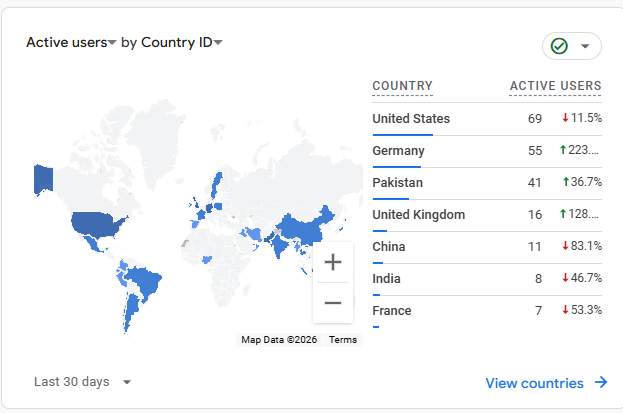
Search data provides the first signal of market potential.
Website owners should analyze country-level performance in Google Analytics and Google Search Console. These platforms show where visitors originate, which queries generate impressions, and how users interact with localized pages.
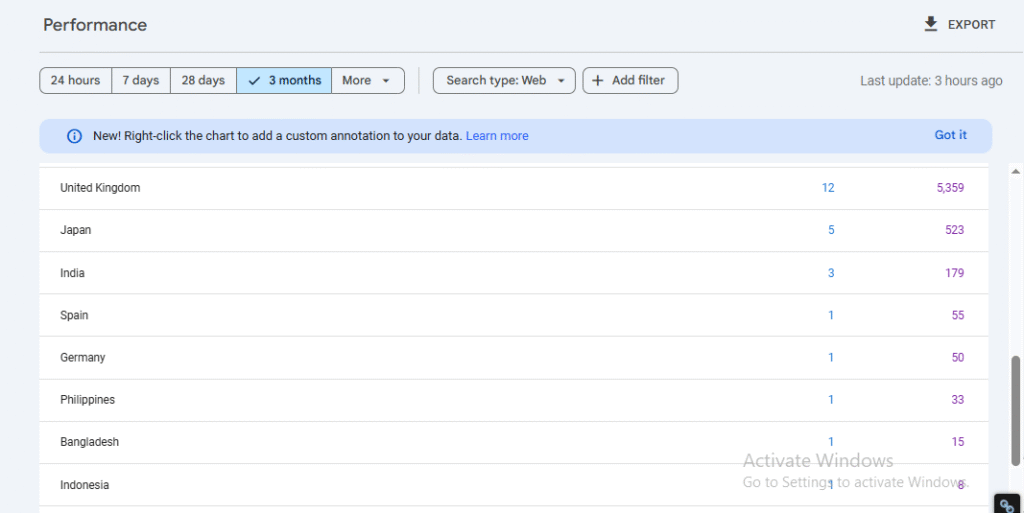
Consistent impressions indicate awareness.
Consistent clicks indicate relevance.
Consistent conversions indicate commercial intent.
Markets that show impressions without engagement usually lack localization. Markets that show traffic without revenue usually lack trust or pricing alignment.
Data determines priority.
Evaluate Competitive Conditions
Demand alone does not guarantee opportunity. Competition determines accessibility.
A healthy market contains multiple successful competitors. A monopolized market limits entry. An empty market signals weak demand.
Businesses can evaluate competition using the Semrush Market Explorer tool.

This tool shows market size, traffic volume, domain distribution, and consolidation levels.
Moderate consolidation signals opportunity. Extreme consolidation signals saturation.
Competitive balance supports growth.
Interpret Market Metrics in Business Context
Raw numbers require interpretation.
High traffic volume does not always indicate profit. Some markets generate heavy browsing with low purchase intent. Other markets generate lower traffic with strong conversion rates.
Key metrics include:
- Market traffic
- Traffic cost
- Total addressable market
- Serviceable market size
These values must align with operational capacity.
Large markets without infrastructure create instability. Small markets with strong margins create sustainability and alanced metrics support expansion.
Measure Brand Recognition by Region
Brand awareness reduces market entry friction.
Users search for brands they trust. Search engines treat branded queries as authority signals.
Businesses should analyze brand-related queries by country. Rising brand searches indicate readiness. Flat trends indicate awareness gaps.
Strong brand presence accelerates localization success.
Decide Between Language and Country Targeting
Targeting strategy affects structure and scalability.
Language targeting serves users who share a language across regions. Country targeting serves users within specific geographic markets.
Search engines treat these signals differently.
English users in the US, UK, and Australia show different pricing expectations and search patterns. These markets require country targeting. Spanish informational content often performs well under language targeting during early stages.
Businesses must base this decision on user behavior, not translation convenience.
Confirm Operational Readiness
Search engines evaluate user satisfaction through engagement signals.
Weak operations damage these signals.
Before expansion, businesses must confirm international payment support, logistics capacity, customer service availability, and return handling systems.
Poor fulfillment increases complaints and bounce rates. High bounce rates reduce visibility.
Operations protect SEO.
Review Legal and Regulatory Compatibility
Each market enforces different regulations.
Governments regulate data privacy, advertising practices, consumer protection, and taxation.
Websites must adapt policies, cookie systems, and disclosures for each region. Non-compliance increases financial and ranking risk.
Legal alignment supports long-term performance.
Analyze Cultural and Buying Behavior
Search behavior reflects cultural norms.
Users differ in price sensitivity, trust expectations, content preferences, and payment habits. Some markets favor detailed explanations. Others prefer simplified confirmation.
Localization teams must adapt tone, layout, and offers accordingly.
Cultural alignment improves engagement and conversions.
Assess Resource Capacity
International SEO requires continuous investment.
Translation, editing, development, monitoring, and quality control never stop.
Under-resourced projects create thin content, broken hreflang clusters, and inconsistent updates. These weaknesses reduce crawl efficiency and authority.
Strong teams sustain growth.
Evaluate Long-Term Profitability
Traffic growth can hide financial losses.
Each market introduces fixed and variable costs. These include localization, compliance management, logistics coordination, and customer support.
Businesses must compare projected revenue against long-term expenses. Markets with low margins require delay. Markets with strong lifetime value deserve priority.
Profitability sustains SEO investment.
Sequence Market Expansion Strategically
Expansion order affects authority growth.
Businesses should expand sequentially, not simultaneously. Each market adds complexity to technical systems and content workflows.
Controlled expansion allows teams to validate performance, correct errors, and refine localization.
Sequential growth reduces volatility.
Why Market Validation Determines Success
Market validation protects both authority and resources.
It prevents empty regional folders, thin localized pages, wasted crawl budget, and unstable ranking signals. Search engines reward structured and predictable growth.
Random expansion weakens credibility.
International SEO succeeds through disciplined selection.
How Search Engines Rank International Websites
Search engines do not rank international websites using a single signal. They evaluate location, language, content relevance, and authority together before assigning visibility in each market. This evaluation happens through a layered system that confirms whether a page belongs to a specific country and language environment.
When these layers align, rankings remain stable. When they conflict, search engines lose confidence and reduce visibility.
According to Google, more than 30% of search queries now show location-based variation, even when users enter identical keywords. This confirms that regional relevance directly affects ranking distribution.
Understanding this process allows businesses to control how search engines interpret their global presence.
How Search Engines Identify Country and Language Relevance
Search engines first determine where a user is located and which language the user prefers. They use IP data, browser settings, device configuration, and historical behavior for this assessment.
After this step, systems analyze website signals.
They review domain extensions, folder structures, language attributes, and hreflang mappings. These elements help crawlers connect users with appropriate pages.
A country-specific domain communicates strong regional intent. A language folder communicates moderate intent. A generic domain communicates weak intent.
When websites provide clear signals, search engines assign geographic relevance confidently. When websites provide mixed signals, systems distribute rankings inconsistently.
Google’s patent “Information Retrieval Based on Historical Data” explains that ranking systems adjust visibility based on geographic interaction patterns over time. This means engines learn which regions engage with which URLs.
This process explains why some pages appear in unintended regions.
How Technical Signals Shape International Rankings
Technical structure forms the foundation of international SEO.
URL hierarchies define market boundaries. Hreflang tags connect language and country versions. Canonical tags prevent duplication conflicts. Internal links reinforce regional separation.
Search engines analyze these elements together.
They build relationship maps between pages. They validate bidirectional references. They test canonical consistency. They measure crawl efficiency.
Broken structures reduce system confidence and low confidence leads to partial indexing, delayed updates, and unstable rankings.
Google’s patent “Language-Independent Ranking of Documents” describes how systems group pages into language clusters before ranking them. Pages outside stable clusters receive reduced visibility.
Technical clarity supports predictable performance.
How Content and Authority Influence Regional Visibility
Search engines evaluate content for market alignment.
They analyze vocabulary, spelling patterns, currency formats, measurement units, and local references. These elements indicate whether content reflects regional intent.
Pages that use local terminology match user expectations. Pages that use foreign phrasing weaken relevance.
Search engines also measure authority by region.
They analyze backlinks from local publishers, citations from regional directories, and mentions from market-specific platforms. These signals validate trust within each country.
Global authority supports brand strength. Regional authority supports local rankings.
Both are necessary.
How Engagement and AI Systems Affect International Results
Search engines monitor user behavior after clicks.
They measure bounce rates, session duration, repeat visits, and conversion patterns. These signals indicate satisfaction within each market.
Low engagement reduces distribution. High engagement expands visibility.
Modern ranking systems also rely on machine learning models. These models evaluate content structure, entity relationships, and consistency across regions. They support AI summaries and personalized SERPs.
Pages with stable technical signals, localized content, and strong authority receive priority in these systems.
Pages with fragmented signals lose exposure.
Why Ranking Alignment Determines International Success
International SEO succeeds through alignment.
- Technical structure must support targeting.
- Content must match regional intent.
- Authority must reflect local trust.
- Engagement must confirm satisfaction.
This alignment creates ranking stability. Websites that maintain this structure scale efficiently. Websites that ignore it depend on short-term fluctuations.
Website Structure for International SEO (Foundation Layer)
Website structure forms the technical foundation of international SEO. Search engines use URL patterns to understand how different regional versions of a website relate to each other. This structure influences how authority flows, how easily pages index, and how safely a site can expand into new markets.
Once a business chooses a structure, changing it later becomes expensive and risky. For this reason, website architecture requires careful planning at the beginning of international expansion.
Search engines such as Google rely heavily on structural signals when assigning geographic relevance. A weak structure limits long-term scalability, even when content quality remains high.
Understanding ccTLDs, Subdomains, and Subfolders
International websites usually use one of three structural models.
A ccTLD (country-code top-level domain) uses a separate domain for each country. Examples include .fr, .de, and .uk. This structure sends the strongest geographic signal. Search engines clearly associate each domain with a specific country.
URL Structure Options for International SEO
Subdomain:
fr.example.com
de.example.com

Subfolder:
example.com/fr/
example.com/de/
Each structure communicates different levels of regional intent and authority distribution.
How Website Structure Affects Authority Flow
Authority flow determines how link equity moves across a website.
With ccTLDs, each country domain builds authority independently. Links to the main brand domain do not automatically benefit other regions. Each market requires its own backlink strategy.
With subdomains, authority partially transfers from the main domain, but search engines often treat subdomains as semi-independent properties. Rankings usually develop more slowly than with subfolders.
With subfolders, all regions share one authority pool. Backlinks to any section strengthen the entire domain. This structure accelerates ranking growth in new markets.
Authority flow influences how quickly a website can establish visibility.
Shared authority improves speed. Separate authority improves isolation.
Cost, Control, and Management Trade-Offs
Each structure creates different financial and operational demands.
ccTLDs require separate hosting, security certificates, analytics setups, and SEO management. Teams must maintain multiple websites. This model increases cost but provides maximum regional control.
Subdomains reduce some infrastructure costs but still require separate technical monitoring and content management. Teams must coordinate updates across properties.
Subfolders centralize management. One CMS, one hosting environment, and one analytics setup support all markets. This model reduces operational complexity and lowers long-term cost.
Control increases with separation. Efficiency increases with consolidation.
Businesses must balance both.
When Each Structure Makes Sense
No structure fits every business.
ccTLDs work best for:
- Large enterprises
- Regulated industries
- Markets with strong national identity
- Brands with local operations
Subdomains work best for:
- Medium-sized companies
- Partial localization strategies
- Testing new regions
Subfolders work best for:
- Most growing businesses
- eCommerce platforms
- SaaS products
- Content publishers
Subfolders suit companies that prioritize speed, scalability, and centralized authority.
Migration and Expansion Safety
Website structure determines migration risk.
Changing from one structure to another requires large-scale redirects, hreflang updates, sitemap revisions, and index reprocessing. These changes often cause temporary ranking losses.
ccTLD migrations carry the highest risk. Each domain requires separate transition management. Errors multiply quickly.
Subdomain migrations also involve complex signal reprocessing.
Subfolder migrations remain simpler because the main domain stays intact. Redirect chains remain shorter. Authority loss remains limited.
Search engines need time to rebuild trust after structural changes. Poor migrations can suppress traffic for months.
Stable structure protects long-term performance.
How Structure Influences Crawl Efficiency
Search engines allocate crawl budget at the domain level.
With ccTLDs, each domain receives separate crawl resources. Weak markets may suffer from slow indexing.
With subdomains, crawl allocation varies by subdomain authority.
With subfolders, the entire site shares crawl budget. Strong sections support weaker ones.
Efficient crawling improves update speed and index coverage.
Poor structure wastes crawl resources.
Choosing the Right Structure for Long-Term Growth
Website structure shapes every other international SEO activity.
It affects:
- Authority distribution
- Technical maintenance
- Localization speed
- Risk exposure
- Expansion cost
Businesses should choose structure based on long-term goals, not short-term convenience.
Companies that plan rapid expansion benefit from centralized systems. Companies that require strong national branding benefit from separation.
The correct choice creates stability but the wrong choice creates permanent friction.
Technical Setup for International SEO
After choosing your site structure, the next step is technical implementation. This step determines whether search engines can crawl, index, and understand your international pages correctly.
Regional XML sitemaps play an important role here. Each country or language version should have its own sitemap. This helps search engines discover localized pages faster and reduces confusion between regions. Websites should submit these sitemaps in Google Search Console.
Crawl budget also needs control. International websites often generate many unnecessary URLs through filters, parameters, and pagination. These URLs waste crawl resources and slow down important updates. Proper robots.txt rules and clean internal linking prevent this problem.
Hosting and CDN setup affects global performance. A website that loads quickly in Europe may load slowly in Asia without a content delivery network. Slow pages increase bounce rates and reduce rankings. A CDN distributes content across regions and improves consistency.
Canonical and hreflang tags must also work together. If a page points to one URL as canonical and another as hreflang, search engines ignore both signals. Technical teams must keep these tags aligned.
Mobile optimization remains critical. Search engines index mobile versions first. Missing translations, broken menus, or hidden content on mobile reduce relevance.
When technical setup works correctly, pages index faster, update reliably, and remain stable in rankings.
Hreflang: The Right Way
Hreflang tells search engines which language and country version of a page to show. Most international SEO failures happen because websites implement hreflang incorrectly.
Every hreflang system must follow three rules:
- Each page must reference itself
- Each page must reference all related versions
- Each referenced page must return the same links
This creates a closed cluster.
Simple Hreflang Example (HTML)
If you have three versions of a page:
- US English
- UK English
- French (France)
<link rel="alternate" hreflang="en-us" href="https://example.com/us/page/" />
<link rel="alternate" hreflang="en-gb" href="https://example.com/uk/page/" />
<link rel="alternate" hreflang="fr-fr" href="https://example.com/fr/page/" />
<link rel="alternate" hreflang="x-default" href="https://example.com/global/page/" />
And each of these URLs must show the same set of tags.
If even one page misses these references, the cluster breaks.
Sitemap-Based Hreflang Example
Large websites usually manage hreflang in XML sitemaps.
Example:
Hreflang Implementation in XML Sitemap
<url>
  <loc>https://example.com/us/page/</loc>
  <xhtml:link rel="alternate" hreflang="en-us" href="https://example.com/us/page/" />
  <xhtml:link rel="alternate" hreflang="en-gb" href="https://example.com/uk/page/" />
  <xhtml:link rel="alternate" hreflang="fr-fr" href="https://example.com/fr/page/" />
</url>
This method scales better and reduces coding errors.
Testing Hreflang
Hreflang breaks easily when URLs change or pages move.
Teams should audit regularly using tools like Screaming Frog.
They should check:
- Missing return tags
- Wrong country codes
- Canonical conflicts
- Non-indexable targets
Correct hreflang does not boost rankings. It prevents wrong placement. Wrong placement destroys traffic.
Localization vs Translation
Translation replaces words. Localization adapts meaning. Most businesses translate content and expect results. This approach rarely works.
Direct translation ignores how users search, buy, and evaluate trust in different regions. As a result, engagement drops and rankings weaken.
For example:
A US product page may say:
“Free shipping in 2–3 days”
A UK version should say:
“Free delivery in 2–3 working days”
A translated version that keeps “shipping” and “days” feels foreign and reduces trust.
What Real Localization Includes
Proper localization adapts:
- Currency (USD → GBP → EUR)
- Measurements (inches → cm)
- Spelling (color → colour)
- Legal text
- Payment methods
- Visual examples
UX also matters. Checkout flows, forms, and support pages must match local expectations.
These details influence conversion rates.
Why Localization Improves SEO
Search engines measure user satisfaction. Localized pages keep users longer, reduce bounce rates, and increase conversions. These signals confirm relevance.
Translation-only pages attract clicks but lose engagement. Search systems prefer pages that feel native.
Practical Localization Example
Spanish Language Variation Example. Spanish for Spain and Spanish for Mexico use different vocabulary.


Spain:
"ordenador"

Mexico:
"computadora"
Using the wrong term weakens relevance. Localized pages use the correct form and search engines reward this accuracy.
Keyword Research for Global Markets (Demand Layer)
International keyword research focuses on how users in different countries actually search. Direct translation rarely reflects real intent. Search engines rank pages that match regional phrasing, not dictionary meanings.
Website owners should start by analyzing country-level queries in Google Search Console. This data shows which terms already generate impressions in each market. These early signals reveal user vocabulary and intent.
After this step, teams should study local SERPs. A keyword that shows blog articles in one country may show product pages in another. This difference indicates intent variation. Content must match the dominant format in each market.
Tools such as Ahrefs and Semrush help compare keyword volume and difficulty by country. These tools also reveal local competitors and related search terms.
Language pitfalls cause many failures.
For example:
In Spain, users search “ordenador portátil.”
In Mexico, users search “laptop.”
Both mean the same product. Only one matches local behavior.
Keyword research must follow usage, not translation.
When research reflects real phrasing and intent, content attracts qualified traffic.
International Content and UX Strategy (Engagement Layer)
Traffic alone does not guarantee results. International SEO succeeds only when users stay, trust the site, and complete actions.
Content localization should follow priority.
Businesses should localize first:
- Homepage
- Category pages
- Product or service pages
- Checkout and support pages
These pages influence conversion most.
Internal linking also matters. Regional pages must link primarily within their own market. This structure reinforces geographic relevance and improves crawl efficiency. Mixed-language linking weakens topical focus.
Navigation design affects usability. Language switchers should remain visible. Country selection should remain simple. Menus should reflect local terminology.
Schema and metadata require localization as well.
Titles, descriptions, and structured data must match regional language and pricing. A French product page should display French schema values. An English page should not reuse them.
UX consistency across regions builds trust.
Trust increases engagement.
Engagement improves rankings.
Practical Localization Example
Pricing & Currency Localization

UK Version:
"Free delivery over £50"

US Version:
"Free shipping over $60"
Keeping UK pricing on US pages reduces conversions. Search engines detect this through behavior data.
Localization must cover both content and experience.
Automation and AI for Scaling (Growth Layer)
Manual localization works for small websites. It fails at scale.
International SEO requires automation to maintain consistency across dozens of regions.
Translation Management Systems (TMS) centralize content workflows. These platforms manage translation memory, terminology, and updates. They reduce duplication and speed up publishing.
AI systems support quality control. They detect terminology errors, tone inconsistencies, and formatting issues. Human editors should review AI output before publication.
CMS integration connects localization with publishing.
Platforms such as WordPress and Shopify support multilingual plugins and API connections. These systems automate content delivery across markets.
A Practical Localization Workflow
Standard Localization Process

CMS → TMS → AI Review → Human QA → Publishing → Monitoring

Workflow Breakdown:

• CMS sends source content to the TMS
• TMS manages translation and version control
• AI tools check language consistency and terminology
• Editors verify accuracy and cultural relevance
• CMS publishes localized updates
• Analytics tools monitor regional performance

Outcome:
This system prevents outdated pages and broken localization.
Why Automation Matters in International SEO
International SEO becomes difficult to manage as the number of countries and languages increases. When teams rely only on manual processes, updates happen at different times, technical tags break, and content slowly loses consistency across regions.
Without automation, some pages receive updates while others remain outdated. Hreflang tags often stop matching new URLs. Translated content starts drifting away from the original meaning. Over time, these gaps weaken authority and reduce search engine confidence.
Search engines interpret this inconsistency as poor quality control.
Automation solves this problem by centralizing content and technical workflows. When systems connect the CMS, translation tools, and quality checks, updates reach all regions at the same time. Teams maintain uniform terminology, formatting, and metadata. Technical signals remain intact.
This consistency allows websites to scale without losing stability.
Instead of reacting to errors, teams prevent them.
Automation does not replace human judgment. It supports it. It ensures that international SEO grows in a controlled, predictable way.
In the long term, automated systems protect rankings, reduce maintenance cost, and preserve authority across markets.
That is why automation is not optional for large international websites. It is a requirement for sustainable growth.
Link Building and Authority by Region (Trust Layer)
Search engines evaluate authority at both global and regional levels. A website may have strong backlinks overall, but still struggle in specific countries if it lacks local trust signals.
International SEO requires authority development in each target market.
Local backlinks play the most important role in this process. Links from regional news sites, blogs, business directories, and industry platforms signal geographic relevance. Search engines treat these links as proof that a website matters within that market.
For example, links from UK publishers strengthen rankings in the United Kingdom. Links from German platforms strengthen rankings in Germany. Global links alone cannot replace this regional validation.
Regional public relations also support authority growth. Mentions in local media, partnerships with regional organizations, and participation in local events generate natural backlinks and brand signals. These mentions improve both visibility and trust.
Internal authority flow matters as well. Websites must distribute link equity within each regional section. US pages should mainly link to other US pages. UK pages should support UK content. This structure reinforces market separation and prevents authority leakage.
Anchor text also requires localization. Users and publishers use different phrasing in different countries. A localized anchor reflects how people actually describe products or services in that region. Generic or foreign anchors weaken relevance.
Over time, this combination of local backlinks, regional mentions, internal structure, and natural anchors builds independent authority in each market.
When each region develops its own trust profile, rankings become more stable and resistant to competition.
Tracking and Optimization (Control Layer)
International SEO cannot succeed without structured measurement. Businesses must track performance by country and language, not just at domain level.
Modern analytics tools make this possible.
Google Analytics 4 allows teams to segment traffic by location, language, device, and conversion source. This segmentation shows which markets generate real value and which only produce surface-level traffic.
Google Search Console provides region-specific data on impressions, clicks, and indexing status. Separate properties or filtered views help monitor each country section independently. This setup reveals technical problems and ranking gaps early.
Rank tracking tools such as Ahrefs and Semrush allow businesses to monitor keyword positions across different locations. These tools show how visibility changes in each market and how competitors perform locally.
Performance tracking must also focus on revenue, not just traffic.
Businesses should measure:
- Conversion rates by country
- Average order value by region
- Customer lifetime value by market
- Support and fulfillment costs
These metrics determine real return on investment. A market with high traffic but low profitability requires adjustment. A smaller market with strong margins deserves further investment.
Regular optimization depends on this data. Teams should review performance monthly, identify weak regions, correct technical or content gaps, and refine localization strategies.
Continuous measurement keeps international SEO predictable. Without tracking, teams rely on assumptions and with tracking, teams rely on evidence. Evidence supports long-term growth.
Legal, Trust, and Compliance (Risk Layer)
When a website expands internationally, it also enters new legal and regulatory environments. Each country applies different rules to data protection, consumer rights, advertising practices, and digital transparency. Search engines consider these factors when evaluating website quality and long-term reliability.
Websites that ignore compliance requirements often face user complaints, regulatory action, and reputation damage. These signals reduce trust and weaken search visibility over time. International SEO remains stable only when legal and operational systems protect users.
Data Protection and Privacy Compliance
Many regions require websites to explain clearly how they collect, store, and process personal data. Privacy policies must match local regulations and remain easy to understand. Generic global policies often fail to meet regional standards and increase legal risk.
Websites must inform users about tracking practices, data retention periods, and account deletion options. They must also provide clear contact channels for privacy-related requests.
Search engines associate transparent data practices with user safety. Websites that follow these standards tend to maintain stronger credibility.
Cookie Consent and Tracking Systems
Most countries require user consent before tracking cookies activate. Proper consent systems display clear banners, allow users to manage preferences, and block non-essential scripts until approval.
Poorly implemented banners frustrate visitors and reduce engagement. This behavior increases bounce rates and weakens ranking signals.
Modern consent platforms help businesses manage compliance across multiple regions while preserving user experience.
Trust Signals and Jurisdictional Stability
Legal compliance alone does not guarantee user confidence. Websites must also demonstrate credibility through visible trust indicators. These include verified business information, secure payment systems, local contact details, customer reviews, and transparent return policies.
Hosting location and data jurisdiction also influence trust. Some regions restrict where user data can be stored and how it can be transferred. Businesses must align hosting strategies with regulatory expectations.
When legal systems, infrastructure, and UX design work together, websites gain predictability. They avoid service interruptions, payment suspensions, and legal disputes.
This stability supports long-term rankings and sustainable growth.
Advanced Scenarios and Edge Cases (Problem-Solving Layer)
As international websites grow, structural and content complexity increases. Simple setups eventually turn into mixed-language systems, overlapping products, and multi-domain environments. These situations create technical conflicts that weaken rankings if they remain unresolved.
Search engines such as Google prioritize consistency. Advanced scenarios usually fail when websites send contradictory signals.
Managing Same-Language, Multi-Region Pages (en-US, en-GB, en-AU)
English-speaking countries share a language but differ in spelling, pricing, and intent. When websites treat these markets as identical, search engines struggle to assign relevance.
The correct approach is to create separate regional versions and connect them through hreflang.
Example:
/us/shoes → hreflang=”en-us”
/uk/shoes → hreflang=”en-gb”
/au/shoes → hreflang=”en-au”
Each version must contain localized pricing, terminology, and metadata. Without these differences, search engines may collapse pages into one version and reduce regional visibility.
Handling Duplicate Products Across Markets
Ecommerce sites often sell identical products in multiple countries. This creates near-duplicate pages that compete with each other.
The solution is controlled duplication.
Each product page must contain:
- Local currency
- Regional shipping details
- Market-specific descriptions
- Local schema data
If localization remains weak, canonical tags should consolidate weaker pages into stronger regional versions.
This prevents internal competition.
Resolving Canonical and Hreflang Conflicts
One of the most damaging errors in international SEO is conflicting signals.
Example of a common mistake:
A UK page points canonically to the US page
But declares itself as en-GB in hreflang
This creates contradiction.
Search engines ignore both signals.
Every localized page must:
- Self-canonical
- Match hreflang targets
- Point to indexable URLs
Regular audits prevent silent failures.
Managing Multi-Domain International Setups
Some enterprises operate multiple country domains.
Example:
example.com
example.co.uk
example.de
example.fr
These systems require centralized coordination.
Hreflang must connect domains. Content updates must stay synchronized. Authority must be built independently.
Without coordination, domains drift apart and lose competitive strength.
Multi-domain systems work only with strong governance.
Why Advanced Scenario Management Matters
Edge cases determine long-term stability.
Small inconsistencies multiply across markets. Over time, they weaken crawl efficiency, authority signals, and ranking confidence.
Systematic problem-solving protects scalability.
International SEO fails quietly before it fails visibly.
Industry Case Example: Blurb’s ccTLD Transition for International SEO
Blurb partnered with Blast Analytics & Marketing to address weak international rankings and limited organic traffic. Before the project, Blurb’s regional visibility remained low, and competitors dominated non-US search results. To fix this, the team advised transitioning from subdomains to country-specific top-level domains (ccTLDs).
The strategy included in-depth competitor analysis, technical guidance, content recommendations, and user experience improvements tailored for each market. After the ccTLD rollout and ongoing optimization efforts, Blurb achieved a 174% year-over-year increase in non-branded international organic traffic, significant improvements in keyword rankings across international domains, and stronger regional domain authority.
This example shows how structural decisions — such as choosing ccTLDs — combined with localized content and technical alignment can drive measurable international SEO growth.
Source: Blurb: International SEO Leads to 174% Increase in Traffic and Huge ROI, Blast Analytics & Marketing case study (https://www.blastanalytics.com/blurb-case-study)
What’s the Future of International SEO?
International SEO is moving away from static, country-by-country optimization and toward dynamic, behavior-driven visibility. Rankings are no longer decided only by keywords and backlinks. They are increasingly shaped by entities, user signals, and AI-led interpretation of intent. The brands that adapt to this shift will dominate cross-border search. The rest will gradually disappear from meaningful visibility.
1. Entity-First Search Is Replacing Keyword-First SEO
Search engines now prioritize contextual understanding over exact-match phrases. Instead of focusing only on keywords like “hotels in Paris”, modern systems evaluate whether your website demonstrates authority around the broader entity “Paris travel.”
That means building structured, interconnected content covering:
- Neighborhoods and districts
- Local regulations and travel rules
- Climate and seasonal patterns
- Events and festivals
- Public transport and mobility
- Safety and cultural norms
Websites that organize content around real-world entities and their attributes create semantic depth. This depth signals topical authority, which is increasingly rewarded over isolated keyword targeting.
2. AI Personalization Will Tailor SERPs by Country and User
Search results are already customized by location and device. The next phase is deeper behavioral personalization, driven by AI models that learn from user interactions.
Future SERPs will increasingly adapt based on:
- Language and interface preferences
- Historical search and click behavior
- Region-specific trending topics
- Content engagement patterns
As a result, international SEO must optimize for behavioral intent rather than static rankings. A page that ranks in one country may appear differently, or not at all, for another user in the same region with different usage patterns.
Optimization will shift from “ranking for keywords” to “matching evolving user journeys.”
3. Zero-Click Results Will Dominate Multilingual Queries
AI overviews, featured snippets, and knowledge panels are expanding across languages and markets. More users now receive answers directly on the results page without visiting websites.
This trend makes technical and semantic precision non-negotiable.
To stay visible in zero-click environments, websites must focus on:
- Accurate and complete structured data
- Clean, crawlable HTML and schema
- Localized factual information
- Clear summaries and definitions
- Original datasets and research
Visibility will increasingly come from being cited, summarized, and referenced inside search interfaces, not only from traditional organic clicks.
4. Predictive Localization Will Pre-Serve Language and Region
Search engines are moving toward proactive localization. Instead of waiting for users to select language or country, AI systems will predict the most relevant version in advance.
Signals used for prediction include:
- Keyboard and OS language
- Browser and app settings
- IP-adjacent and network data
- Past geographic behavior
This will require websites to support intelligent content delivery through:
- Advanced language and region selectors
- Real-time version switching
- Stable URLs with hreflang accuracy
- UX systems that preserve session continuity
Poor localization architecture will result in mismatched content delivery and lost engagement.
Final Conclusion: The New Reality of International SEO
International SEO is no longer about publishing more country pages, translating keywords, or duplicating templates across markets.
It is about building adaptive, entity-driven ecosystems that respond to how users think, search, and behave in real time.
Modern international visibility depends on three pillars:
- Semantic authority built around real-world entities
- High-quality localized data and technical precision
- Systems that adapt dynamically to user signals and AI predictions
Brands that treat international SEO as a structural, data-driven discipline will compound visibility across markets. Those that rely on outdated keyword replication strategies will see diminishing returns, regardless of content volume.
In the coming years, global search success will not belong to the biggest websites. It will belong to the most intelligent ones.
Ready to Scale Internationally Without Losing Rankings?
Frequently Asked Questions
Struggling to appear inside AI Overviews

Ermus is an SEO specialist and content writer with 2 years of experience in driving website growth through effective search strategies and engaging content. Specializing in local SEO, on-page/off-page optimization, and semantic content, she applies Koray Tuğberk GÜBÜR’s holistic SEO methods to build authority and relevance across topics. Ermus stays ahead of the curve, constantly refining strategies to adapt to evolving search trends.