Is digital marketing legit?
Yes, digital marketing is a legitimate and measurable business practice used by millions of brands worldwide. Backed by data analytics, SEO, and performance tracking, it helps companies generate leads, increase ROI, and build brand visibility online. According to Statista (2025), global digital ad spending surpassed $667 billion, proving the real business impact of digital channels.
In the last decade, digital marketing has evolved from an experimental trend to a proven business engine. Yet, many entrepreneurs and small business owners still ask: is digital marketing actually legit?
Skepticism often arises from failed campaigns, misleading agencies, or the flood of “get-rich-quick” ads that misrepresent what real marketing looks like.
In truth, digital marketing is as legitimate as your strategy, execution, and measurement. It combines creativity, data, and technology to connect brands with audiences in measurable ways.
Insight crafts marketing agency here breaks down the biggest myths, real-world proofs, and actionable insights that reveal why digital marketing isn’t just real, it’s essential.
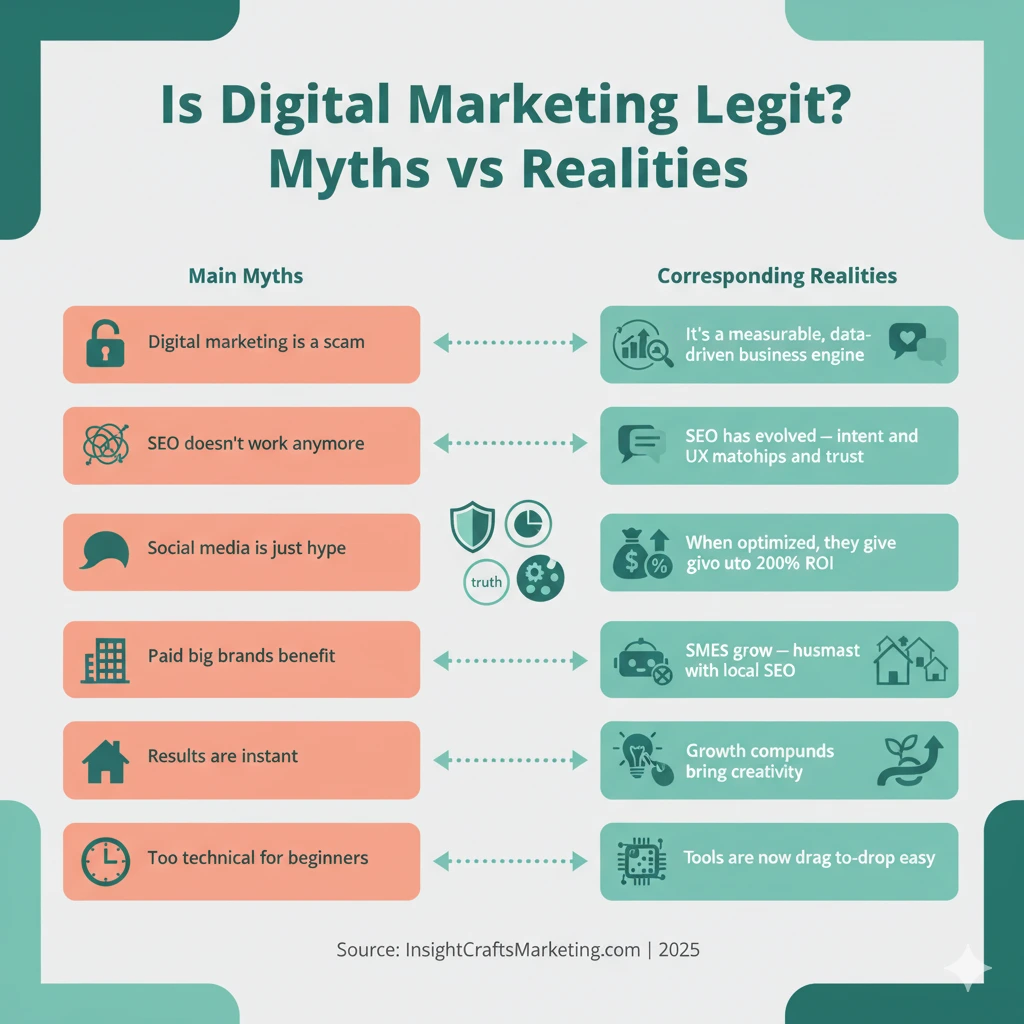
Myth #1: Digital Marketing Is a Scam
Reality: It’s a Data-Driven Business Function, Not a Shortcut
Digital marketing is often misunderstood because of unverified freelancers or agencies promising unrealistic overnight results. But legitimate marketing is built on strategy, analytics, and ethical execution.
According to HubSpot’s State of Marketing Report 2025, companies using structured digital marketing frameworks see 3× more qualified leads and 62% lower acquisition costs than those relying only on traditional methods.
Legitimate digital marketing includes:
Measurable KPIs like traffic, CTR, and conversions
Transparent reporting via GA4, Search Console, and CRM tools
Sustainable tactics (SEO, content marketing, paid ads, and automation)
Myth #2: SEO and Content Don’t Work Anymore
Reality: SEO Has Evolved, Not Died
The misconception that “SEO is dead” stems from outdated tactics. Modern SEO focuses on intent, topical authority, and user experience.
According to SEMrush (2025), 68% of online experiences start with a search engine, proving how relevant organic traffic remains.
Successful SEO today blends:
Entity-based optimization (connecting topics, tools, and brand mentions)
Content clusters (pillar + supporting blogs)
AI-aided content refinement for precision targeting
Pro Tip:
Focus on building topic clusters around your brand expertise, e.g., “Digital Marketing → SEO → AI Tools → Analytics.” It compounds authority across your site.
Myth #3: Social Media Marketing Is Just Hype
Reality: It’s a Legit Relationship-Building Channel
While vanity metrics (likes and followers) can be misleading, social media builds trust, community, and direct feedback loops.
According to Sprout Social Index 2025:
90% of consumers follow at least one brand online
68% say social content influences their purchase decisions
Platforms like LinkedIn and Instagram now drive measurable conversions through ad analytics, shoppable posts, and UGC campaigns.
Pro Tip:
Track metrics that matter, such as engagement rate, share ratio, and CTR, instead of just follower counts. Social proof grows through relevance, not reach alone.
Myth #4: Paid Ads Are a Waste of Money
Reality: When Optimized, They Deliver Exceptional ROI
PPC campaigns fail only when executed without clear targeting, funnel structure, or data tracking. Platforms such as Google Ads, Meta Ads Manager, and LinkedIn Campaign Manager give advertisers granular control over audiences and budgets.
According to WordStream (2025), businesses earn an average ROI of 200% from well-optimized PPC campaigns.
Legitimate ad strategies include:
A/B testing for creatives and CTAs
Conversion tracking via GA4 + UTM parameters
Remarketing for warm leads
Pro Tip:
Start small. Run A/B tests with two ad variations and scale only the version that achieves at least 2.5× ROAS.
Myth #5: Only Big Brands Benefit from Digital Marketing
Reality: SMEs and Local Businesses Thrive the Most
Digital marketing levels the playing field. With the right tools and niche targeting, small businesses can outperform bigger competitors in localized search results.
Example: A local salon using Google Business Profile and social storytelling can dominate local search even against national franchises.
Statista’s 2025 SME Report shows that 78% of small businesses using consistent digital marketing campaigns grew revenue within 12 months.
Myth #6: AI Is Making Marketers Obsolete
Reality: AI Is a Partner, Not a Replacement
Artificial intelligence automates data analysis, personalization, and copy generation, but it still relies on human creativity and brand strategy.
A ScienceDirect (2025) study found that AI-assisted campaigns deliver 25% faster execution and 40% higher engagement, but only when supervised by marketing teams.
AI supports marketers by:
Automating repetitive tasks (scheduling, data entry)
Optimizing targeting and bid adjustments
Personalizing user experiences at scale
Myth #7: Results Are Instant
Reality: Digital Marketing Compounds Over Time
Like fitness, digital marketing works through consistency. Campaigns often take 3–6 months to show full ROI depending on niche and competitiveness.
Brands combining organic (SEO + content) with paid (PPC + retargeting) see the most sustainable growth.
According to the Content Marketing Institute (2025), 81% of marketers using long-term content strategies reported measurable ROI increases year-over-year.
Myth #8: It’s Too Complicated for Non-Tech People
Reality: Tools Are Becoming Simpler and More Accessible
Modern marketing platforms like Canva, HubSpot, Mailchimp, and Google Ads now include drag-and-drop builders, templates, and AI-powered recommendations.
Most small businesses succeed without in-house tech teams because of:
Low-cost automation tools
Free learning resources (Google Skillshop, Coursera, HubSpot Academy)
Simplified dashboards for reporting
Still unsure whether digital marketing truly works for your industry?
Real-World Proof: The Numbers Behind Legit Digital Marketing
Data-backed insights show why digital marketing continues to deliver measurable business impact across industries. The following benchmarks illustrate how real brands gain tangible growth through strategic execution:
| Business Metric | Impact from Digital Marketing | Source / Notes |
|---|---|---|
| ROI | Average $5.44 return for every $1 spent on marketing automation | The CMO 2025 Report |
| Lead Generation | 451% increase in qualified leads via AI + automation | Firework 2025 |
| Customer Retention | 12% reduction in marketing overhead + higher loyalty | WinSavvy 2024 |
| Cost Efficiency | $667 B global digital ad market proves shift from traditional media | Statista 2025 |
| Productivity | 14.5% sales increase through automation tools | Grand View Research 2025 |
Key takeaway: Real businesses across industries confirm that digital marketing is not only legitimate but one of the highest-ROI investments in modern business strategy.
How to Verify Whether Your Digital Marketing Is Legit
Set Clear KPIs — Define conversion goals, not vanity metrics.
Track Everything — Use GA4, Search Console, and CRM dashboards.
Demand Transparency — Request monthly performance reports.
Check Strategy Alignment — Ensure campaigns link back to core business goals.
Review Ethics — Avoid fake followers, click farms, and plagiarized content.
Pro Tip:
A legitimate marketing partner never guarantees instant ranking or viral reach, only measurable growth tied to data.
Conclusion: Why Digital Marketing Is 100% Legit
Digital marketing is not a fad or scam; it’s the modern foundation of business growth. From local startups to multinational enterprises, every brand that invests in strategy, analytics, and authentic communication sees measurable returns.
While myths persist, data, technology, and transparency prove the legitimacy of digital marketing every day. The challenge isn’t whether it works, it’s whether your strategy is built to perform.
Don’t Let Misinformation Hold You Back.
Frequently Asked Questions
1. Why do people think digital marketing is a scam?
2. How can I tell if an agency is legit?
3. Does digital marketing really make money?
4. What’s the average timeline to see results?
5. Are there fake digital marketers?
6. How do I start small with digital marketing?
7. Is digital marketing worth it in 2026?
8. What’s the safest way to learn digital marketing?

Irum doesn’t just write..she builds stories that cut through the noise. Her words carry clarity, edge, and intention, crafted for readers who expect more than the ordinary.