Many car recovery websites struggle to rank because their structure is too weak.
The business may provide excellent recovery services, operate across Birmingham, and answer calls quickly, but Google still struggles to understand the website properly.
That creates a visibility problem.
A weak website structure limits rankings, local relevance, keyword coverage, Google Maps support and inbound recovery calls.
Most recovery businesses think ranking higher is only about adding keywords.
It is not.
Google needs a clear structure that explains what services you provide, where you operate, which searches your pages should rank for, and how your content connects together.
Without that structure, competitors with stronger websites usually dominate visibility even if their actual recovery service is not better offline.
This is why car recovery website pages SEO matters.
A properly structured recovery website helps Google understand your business faster, improves local rankings and creates more opportunities for inbound calls from urgent searches.
Your website should not work like an online leaflet.
A car recovery website should work like a local visibility system.
Every important page should tell Google one clear thing: what service you offer, where you offer it, and why customers can trust you.
Why Most Car Recovery Websites Fail to Rank
Many recovery websites are built like digital business cards.
They often contain one generic homepage, limited service information and almost no supporting content. That structure weakens visibility heavily because Google cannot confidently understand the business depth, local relevance or recovery expertise properly.
A customer searching for “breakdown recovery Birmingham” expects something very different from someone searching for “emergency towing near Solihull”.
If your website only contains one broad page trying to rank for every search, Google receives weak relevance signals and rankings become unstable.
This is why stronger recovery websites separate services, locations, educational content and support pages properly.
Google wants clarity.
Customers want clarity too.
A properly structured website helps both understand the business faster.
More structure creates more visibility.
More visibility creates more recovery calls.
The One-Page Website Problem
Imagine a driver breaks down near Solihull and searches “emergency towing near me”.
You offer the service, but your website only has one generic homepage.
No Solihull page, no emergency towing page and no clear breakdown recovery content.
Google now has to guess whether your website is relevant. A competitor with a dedicated service page and local area page usually has the stronger signal.
How Google Understands a Recovery Website
Google does not rank websites the way many business owners imagine.
It does not simply scan keywords and decide which website deserves to rank first.
Google tries to understand the purpose of every page, how pages connect together, what topics the site covers deeply, and whether the website genuinely helps users searching for recovery services.
That means every page on a recovery website should serve a clear purpose.
A homepage builds broad authority and trust. Service pages explain recovery services in detail. Location pages strengthen suburb relevance. Educational blogs support topical authority and semantic depth.
When these pieces connect together properly through internal linking, Google understands the website as a stronger local recovery entity instead of a thin generic business site.
That is where rankings improve.
The recovery businesses dominating Google visibility are usually the businesses with stronger structural clarity than competitors.
Google looks at how your whole website connects.
Google does not only look at one page in isolation. It looks at how the full website connects.
A homepage, service page, location page and blog article can support each other when they are linked properly.
That is why website structure matters as much as the content on each individual page.
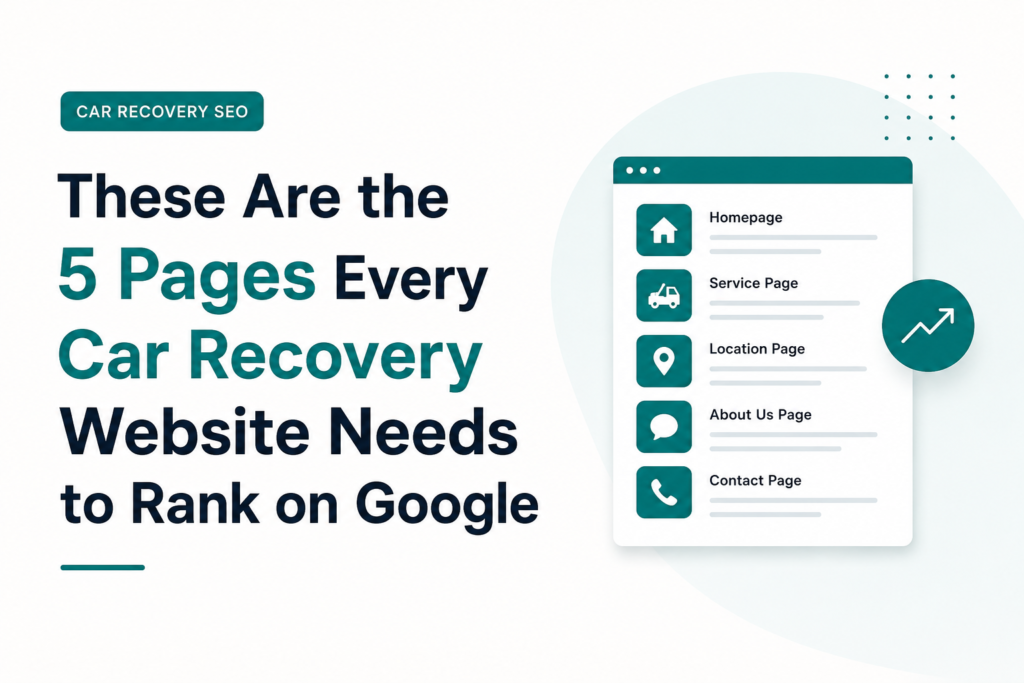
Page 1: The Homepage
The homepage is the foundation of the entire website.
Its role is not to rank for every keyword possible. Its job is to establish who the business is, what services are offered, where the business operates, and why customers should trust the company quickly.
For a Birmingham recovery company, the homepage should clearly reference:
- car recovery
- breakdown recovery
- towing services
- Birmingham coverage
- emergency response intent
It should also guide visitors naturally toward service pages, contact actions and trust-building sections.
Many weak recovery homepages fail because they contain generic wording, weak headings, poor local relevance and unclear calls to action.
Customers searching for urgent help should understand the business within seconds.
Google should also immediately understand the core topic of the website.
A strong homepage becomes the authority hub connecting the rest of the site structure together.
Page 2: The Main Service Page
The service page is one of the most important ranking assets on a recovery website.
This page helps target high-intent searches related to breakdown recovery, roadside assistance, emergency towing and car recovery services.
A strong service page should explain the service clearly while reinforcing Birmingham relevance, emergency intent, trust signals and conversion paths naturally throughout the content.
Customers want quick answers.
They want to know:
- What services do you offer?
- How quickly can you help?
- Which areas do you cover?
- Why should they trust you?
- How can they contact you immediately?
Many recovery businesses weaken rankings because their service pages contain very little useful information.
Thin content creates weak relevance signals.
Google struggles to understand vague pages and customers struggle to trust them.
Strong service pages should include structured headings, FAQs, local references, visible phone CTAs and internal links supporting related recovery topics.
For a deeper breakdown, explore our car recovery SEO services in Birmingham.
Page 3: Location Pages
Location pages help recovery businesses rank across multiple local searches instead of relying only on broad Birmingham keywords.
Many towing companies ignore suburb-level visibility completely. That creates a major ranking gap.
A strong recovery website should build pages targeting important local areas such as:
- Sutton Coldfield
- Erdington
- Solihull
- Northfield
- Edgbaston
- Harborne
These pages help Google understand local relevance more clearly while improving visibility for suburb searches, “near me” intent and local recovery queries.
A properly built location page should include area relevance, local roads or landmarks, service context and clear mobile-friendly calls to action.
Weak location pages usually fail because they are duplicated, thin or obviously keyword stuffed.
Google wants useful local relevance.
Not doorway spam pages.
Strong location pages create additional opportunities for recovery visibility across Birmingham and the West Midlands.
More local visibility creates more opportunities for recovery calls.
Page 4: Google Business Profile and Local SEO Support Content
Many recovery businesses underestimate the importance of support content.
This is one of the biggest mistakes in local SEO.
Google wants evidence that your business genuinely understands recovery services, local search behaviour, customer intent and Google Maps relevance.
Support content helps create that authority naturally.
This includes educational blogs and guides related to:
- Google Business Profile optimisation
- local SEO
- map rankings
- customer trust
- review management
- recovery visibility
A strong support content strategy reinforces topical authority, semantic depth, internal linking strength and local relevance at the same time.
This is one reason specialist recovery websites outperform weak generic local business sites.
They build stronger topical ecosystems around the recovery industry itself.
For example, a detailed Google Business Profile optimisation guide helps strengthen local map relevance while supporting service page authority simultaneously.
That structure helps Google understand the business more deeply.
Page 5: Educational Blog Content
Educational blogs are one of the strongest long-term SEO assets for a recovery website.
Many recovery businesses ignore blogging because they focus only on service pages. That limits search visibility heavily over time.
Blog content helps target long-tail searches, customer questions, pricing searches, competitor comparisons and informational recovery topics that service pages alone cannot fully cover.
These blogs also strengthen the entire website structure through internal linking.
Topics such as:
- cost guides
- competitor analysis blogs
- towing SEO strategy blogs
- Google Maps blogs
- recovery visibility guides
all help reinforce topical authority around recovery-related searches.
Educational content also builds trust.
A recovery business that explains rankings, Google Maps, reviews, visibility problems and local search behaviour naturally appears more authoritative than competitors with almost no supporting content.
That authority affects both rankings and customer confidence.
For broader strategy support, read our best SEO strategies for towing companies UK 2026 guide.
Blog content should not be written randomly.
Each article should support a service, a location, a customer question or a Google Maps visibility issue.
Random blogs may add words to the website, but strategic blogs add authority.
Why Internal Linking Matters for Recovery Websites
Internal linking helps connect the entire recovery website structure together.
Google uses internal links to understand relationships between pages, topic hierarchy, semantic relevance and page importance.
Without internal linking, pages become isolated.
That weakens authority flow across the website.
Blogs should support service pages. Service pages should reinforce location pages. Educational content should connect naturally to Google Business Profile and visibility-related topics.
This creates a stronger semantic structure while improving user navigation at the same time.
Customers can move naturally between:
- recovery services
- local areas
- educational resources
- conversion-focused pages
That improves both rankings and engagement signals.
Strong recovery websites are usually well-connected websites.
Internal links create clear routes through your website.
A recovery website without internal links is like a city with blocked roads.
Pages may exist, but Google and customers cannot move through them easily.
Internal links create clear routes between services, locations, blogs and enquiry pages.
What Happens When These Pages Are Missing
A weak recovery website structure creates visibility gaps everywhere.
Missing pages usually lead to weaker rankings, lower topical authority, reduced local relevance and fewer opportunities to appear in recovery searches.
A website without location pages struggles with suburb visibility.
A website without blogs lacks topical depth.
A website without proper service pages weakens commercial relevance.
A website without internal linking creates poor semantic clarity.
Over time, competitors with stronger website architecture dominate more searches and capture more recovery calls.
This is why website structure should never be treated as simple web design.
It is a visibility system.
The Recovery Websites That Rank Strongest
The strongest recovery websites are usually structured intentionally.
They separate services clearly, target local areas properly, build educational authority and strengthen Google Maps relevance through consistent internal linking and topical depth.
Most importantly, they create clear signals for both Google and customers.
That clarity improves:
- rankings
- trust
- visibility
- conversion potential
- recovery enquiries
Every page on the website should contribute to a larger local visibility system instead of existing independently.
That is how strong recovery websites outperform weaker competitors over time.
Conclusion
Many car recovery websites struggle to rank because their structure is too weak.
Google needs clear signals to understand what services you provide, where you operate, how your pages connect together and why your business is relevant for recovery searches.
That is why proper page structure matters so heavily.
A strong recovery website includes:
- a clear homepage
- dedicated service pages
- local location pages
- educational support content
- strategic internal linking
Together, these pages create stronger local visibility, better rankings and more opportunities for inbound recovery calls.
Every page should support the wider recovery visibility system instead of existing independently.
Book Your Free SEO Audit
Find out exactly why your car recovery business may be losing calls and how to fix it fast.
Request Your Free SEO Audit →Frequently Asked Questions

Irum doesn’t just write..she builds stories that cut through the noise. Her words carry clarity, edge, and intention, crafted for readers who expect more than the ordinary.