Many car recovery websites struggle to rank because their structure is too weak. The business may offer fast recovery services, cover Birmingham properly, and answer calls quickly, but the website still gives Google unclear signals.
That creates a visibility problem.
Car recovery website pages SEO matters because Google needs to understand what services you provide, where you operate, which searches each page should rank for, and how your content connects together. Customers need the same clarity. They want to know what you do, where you cover, and how to call you fast.
Most recovery businesses think ranking higher is only about adding keywords. It is not. A strong website needs the right pages, clear internal links, local relevance, and conversion-focused calls to action.
Google’s own SEO Starter Guide explains that SEO helps search engines understand your content and helps users find your site through search. For recovery websites, that means your pages must be organised around real services, real areas, and real customer intent.
Without that structure, competitors with better websites can dominate Google visibility, even if their offline recovery service is not better.
What Keywords Should a Car Recovery Website Target?
A car recovery website should target service keywords, emergency keywords, location keywords, problem-based searches, and Google Business Profile keywords. The strongest keywords are not always the highest-volume terms. For recovery businesses, keywords with urgent call intent, such as “24 hour car recovery Birmingham” or “emergency car recovery near me”, are often more valuable because the searcher is closer to calling.
Why Most Car Recovery Websites Fail to Rank
Many recovery websites are built like digital business cards. They often contain one generic homepage, limited service information, no clear local structure, and almost no supporting content.
That is not enough.
A customer searching for “breakdown recovery Birmingham” expects something different from someone searching for “emergency towing near Solihull”. If your website only has one broad page trying to rank for every search, the relevance signals become weak.
A stronger recovery website separates services, locations, educational content and support pages properly. Each page has a clear job. The homepage builds broad trust. Service pages target recovery services. Location pages build local relevance. Blog content answers helpful questions and supports the money pages.
Clear page structure helps both Google and customers understand the business faster. That creates stronger ranking signals and a smoother path to the phone call.
For more detail on how this fits into search visibility, read the full car recovery SEO services in Birmingham guide.
How Google Understands a Recovery Website
Google does not rank a recovery website only because the homepage repeats a keyword several times. It looks at the purpose of each page, the relationship between pages, the topics the website covers, and whether the content helps users searching for recovery services.
That means every page needs a clear purpose.
A homepage should not do the job of every service page. A service page should not try to target every suburb. A location page should not be a thin copy of another area page. Blog content should not sit disconnected from the main commercial pages.
Internal links help connect this structure. Google’s link best practices explain that links help Google find pages and understand what linked pages are about. For a recovery website, that means your blogs, service pages, location pages and support pages should connect naturally.
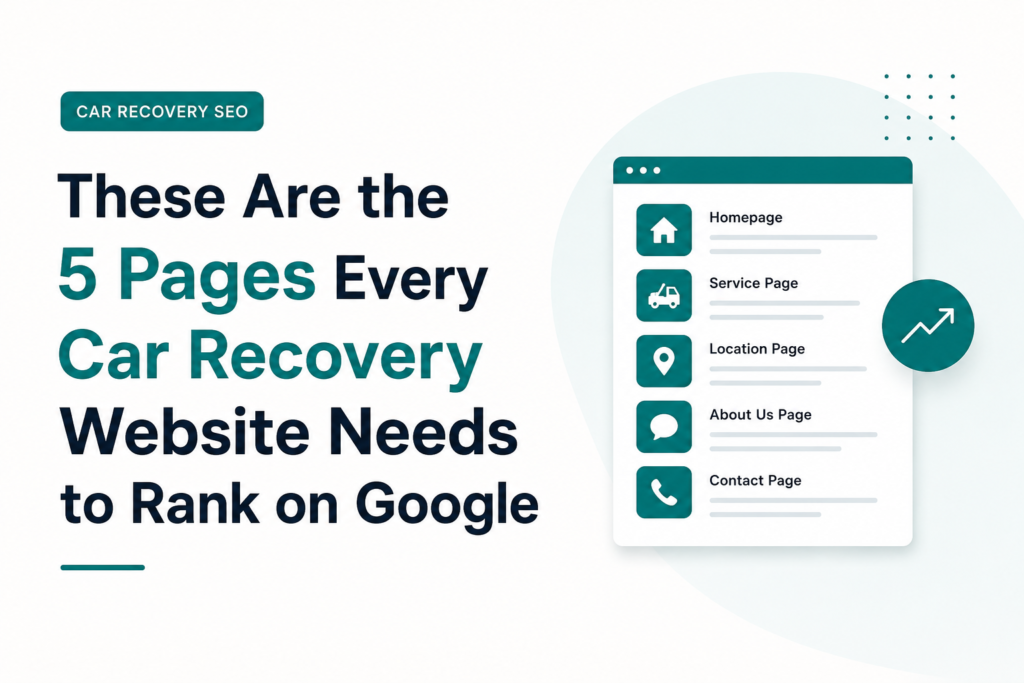
| Page Type | Main SEO Job | Why It Matters |
|---|---|---|
| Homepage | Builds main business and location relevance | Helps Google understand the core recovery service |
| Service Page | Targets high-intent recovery searches | Supports breakdown recovery, towing and roadside assistance keywords |
| Location Pages | Builds suburb-level visibility | Helps target areas like Erdington, Solihull and Sutton Coldfield |
| GBP Support Content | Supports map pack relevance | Strengthens Google Business Profile and local trust signals |
| Blog Content | Builds topical authority | Answers long-tail questions and supports service pages |
The recovery websites that perform better are usually not just better-looking. They are better structured.
Page 1: The Homepage
The homepage is the foundation of the whole recovery website. Its job is not to rank for every keyword possible. Its job is to establish who the business is, what services are offered, where the business operates, and why customers should trust the company quickly.
For a Birmingham recovery company, the homepage should clearly reference:
- car recovery
- breakdown recovery
- towing services
- Birmingham coverage
- emergency response intent
- clear phone contact
A weak homepage usually has generic wording, unclear headings, poor local relevance and no strong call to action. That makes it harder for customers to act and harder for search engines to understand the core service.
A strong homepage should guide visitors naturally towards service pages, local area pages, contact options and trust-building sections.
The first screen matters most. A customer searching for urgent help should understand the business within seconds. They should not have to scroll through vague text before finding the service area or phone number.
Page 2: The Main Service Page
The main service page is one of the most important ranking assets on a recovery website. This page helps target high-intent searches related to car recovery, breakdown recovery, roadside assistance, emergency towing and vehicle recovery services.
A strong service page should answer the questions customers care about:
- What recovery services do you offer?
- How quickly can you help?
- Which areas do you cover?
- Do you offer emergency support?
- Why should customers trust you?
- How can someone call immediately?
Many recovery businesses weaken their rankings because their service pages are too thin. A short paragraph and a phone number are not enough. Thin pages create weak relevance signals and give customers very little reason to trust the business.
A stronger service page should include structured headings, useful service explanations, local Birmingham references, FAQs, trust signals, clear phone CTAs and links to related pages.
For a deeper breakdown, explore our car recovery SEO services in Birmingham.
Page 3: Location Pages
Location pages help recovery businesses rank across multiple local searches instead of relying only on broad Birmingham keywords. Many towing companies ignore suburb-level visibility completely. That creates a major ranking gap.
A strong recovery website should build useful pages for important local areas such as:
- Sutton Coldfield
- Erdington
- Solihull
- Northfield
- Edgbaston
- Harborne
- West Midlands
These pages help strengthen local relevance for suburb-based searches and “near me” intent. They also give customers more confidence that the business genuinely covers their area.
A good location page should include:
- area name
- nearby postcodes
- roads or local references
- recovery services offered in that area
- callout context
- mobile-friendly phone CTA
- internal links to service pages
Weak location pages usually fail because they are duplicated, thin, or obviously keyword stuffed. Changing only the town name across multiple pages is not enough. That kind of content does not build trust.
Strong location pages create more opportunities for recovery visibility across Birmingham and the West Midlands.
A keyword-led website structure also needs proper mapping. This is explained further in the car recovery website keywords UK 2026 guide.
Page 4: Google Business Profile Support Content
Google Business Profile support content helps connect your website with local map visibility. Many recovery businesses underestimate this part of local SEO, but it matters because map pack visibility is often where urgent recovery calls happen.
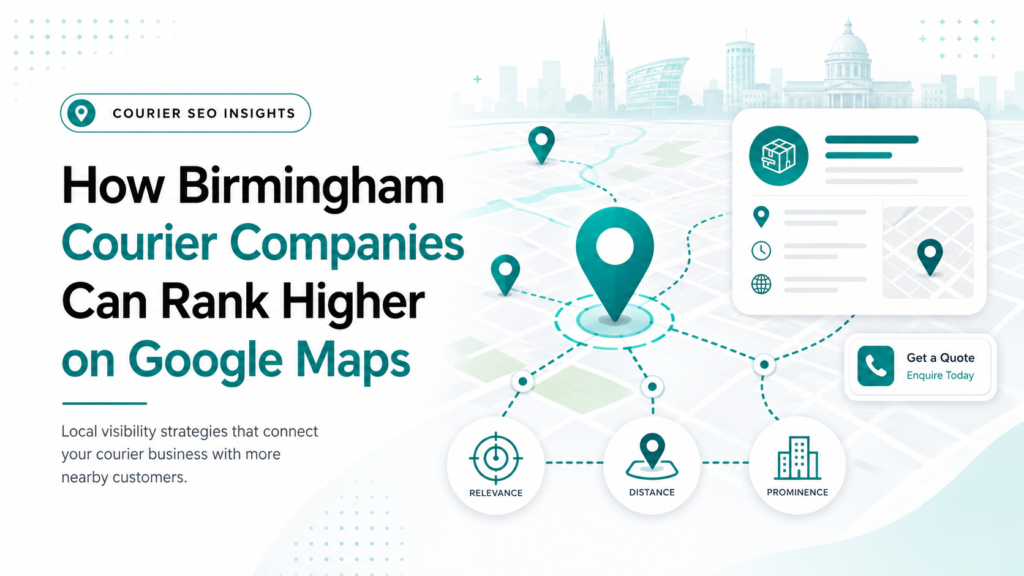
Google’s official guidance on improving local ranking explains that local results are mainly based on relevance, distance and prominence. Recovery websites should support these signals with clear service pages, local content, reviews, consistent details and useful Google Business Profile information.
Support content can include guides and pages related to:
- Google Business Profile optimisation
- local SEO
- map rankings
- customer reviews
- NAP consistency
- local trust signals
- recovery visibility
This content helps build topical authority around local search. It also gives you useful internal pages to link from service pages, blogs and location pages.
For example, a detailed Google Business Profile optimisation guide can explain how categories, services, reviews, photos, posts and local consistency support map visibility.
This type of content should not be written as generic SEO theory. It should stay specific to recovery businesses. A car recovery owner does not need a lecture about digital marketing. They need to understand how Google Maps can help bring more emergency calls.
Page 5: Educational Blog Content
Educational blog content is one of the strongest long-term assets for a car recovery website. Many recovery businesses ignore blogging because they focus only on service pages. That limits search visibility over time.
Service pages target commercial searches. Blogs support the wider search journey.
Good blog topics for recovery websites include:
- how much car recovery SEO costs
- local SEO vs Google Ads for car recovery
- how long SEO takes for recovery businesses
- Google Maps tips for towing companies
- common recovery website SEO mistakes
- how to get more calls from Google
- best SEO strategies for towing companies
These blogs help target long-tail searches, customer questions, pricing concerns, comparison queries and local SEO problems that service pages cannot fully cover.
Blog content also strengthens internal linking. A blog about Google Maps can link to a GBP guide. A blog about website speed can link to the main SEO service page. A blog about keywords can link to location page guidance.
For broader strategy support, read our best SEO strategies for towing companies UK 2026 guide.
Educational content should be useful. Do not publish thin blogs just to fill a content calendar. Every article should answer a real question and support the wider recovery SEO structure.
Why Internal Linking Matters for Recovery Websites
Internal linking connects the entire recovery website structure together. It helps users move between services, areas, resources and conversion pages. It also helps search engines understand page relationships and topic hierarchy.
Without internal linking, pages become isolated.
That weakens the site structure.
A strong internal linking system should connect:
- blogs to service pages
- service pages to location pages
- location pages to core services
- GBP content to local SEO pages
- commercial pages to audit or contact pages
For example, a blog about car recovery website structure should link to the main service page and the contact page. A location page for Solihull should link back to the main car recovery service page. A GBP guide should link to relevant local SEO and map pack content.
Related support articles can also strengthen the cluster. For example, the car recovery website speed SEO guide supports technical SEO, while the local SEO vs Google Ads for car recovery guide supports channel comparison and decision-making.
This creates a stronger structure while improving navigation for real customers.
A customer should be able to move naturally from an educational blog to a service page, then to a consultation or call option. That is how content supports conversion instead of sitting alone.
What Happens When These Pages Are Missing
A weak recovery website structure creates visibility gaps. Missing pages usually lead to weaker rankings, lower topical authority, reduced local relevance and fewer opportunities to appear in recovery searches.
Here is what usually happens:
- A website without service pages struggles with commercial recovery terms.
- A website without location pages struggles with suburb visibility.
- A website without blogs lacks topical depth.
- A website without GBP support content misses local map opportunities.
- A website without internal links creates poor page relationships.
This is why website structure should not be treated as simple design. It is part of the visibility system.
A nice-looking website can still fail if the page structure is weak. A recovery business needs pages that explain services, locations, trust signals and customer problems clearly.
If these pages are missing, competitors with stronger architecture can capture more searches and more recovery calls.
The Recovery Websites That Rank Strongest
The strongest recovery websites are usually structured intentionally. They separate services clearly, target local areas properly, build educational authority and support Google Maps relevance through useful content and internal links.
Most importantly, they create clarity.
That clarity helps with:
- rankings
- trust
- visibility
- user experience
- conversion potential
- recovery enquiries
Every page should contribute to the wider local visibility system. The homepage should introduce the business. Service pages should target recovery jobs. Location pages should build local relevance. Blog content should answer questions and support commercial pages.
When the structure works together, the website becomes more than an online brochure. It becomes a search visibility asset.
You can also contact Insight Crafts Marketing to check whether your current car recovery website pages are helping or holding back your rankings.
Conclusion
Many car recovery websites struggle to rank because their structure is too weak. Google needs clear signals to understand what services you provide, where you operate, how your pages connect together and why your business is relevant for urgent recovery searches.
A strong recovery website should include a clear homepage, dedicated service pages, local location pages, Google Business Profile support content, educational blogs and strategic internal links.
Together, these pages create stronger local visibility, better rankings and more opportunities for inbound recovery calls.
Ready to Rank on Page 1 in Birmingham?
If you want your car recovery business to rank on page 1 in Birmingham, contact Insight Crafts Marketing today.
Contact Us