AI SEO is the process of making a website and its public business information easier for search engines and AI-assisted platforms to discover, understand and use when answering relevant questions.
For a UK courier company, this means clearly explaining:
- Which delivery services the company provides
- Where it genuinely operates
- Which customers and delivery needs it supports
- How collections, quotes and bookings work
- What evidence supports its business claims
- How customers can contact the company
AI SEO does not mean publishing hundreds of artificial articles, adding a secret piece of code or repeating questions across every page.
It also does not replace traditional search engine optimisation.
Google states that its established SEO best practices remain relevant to AI Overviews, AI Mode and other AI-supported search experiences. It does not require a special AI schema, machine-readable file or separate type of website for inclusion. Google’s guidance for AI features makes that position clear.
The practical objective is simple:
Make the courier business easy to find, understand, verify and contact across conventional and AI-assisted search.
What Does AI SEO Mean?
The term “AI SEO” is used loosely across the marketing industry. It can describe two different activities:
- Using artificial intelligence to assist with SEO work
- Optimising a website for discovery through AI-assisted search experiences
This guide focuses mainly on the second meaning.
AI SEO for courier companies concerns how business information may be discovered and presented through experiences such as:
- Google AI Overviews
- Google AI Mode
- ChatGPT search
- Bing and Microsoft AI-assisted search
- Other search assistants that use current web information
A customer may still enter a short traditional search such as:
same-day courier Birmingham
However, that customer may also ask a longer question:
Which courier companies can collect an urgent legal document from Birmingham and deliver it to Manchester today?
An AI-assisted system may attempt to understand several parts of that question:
- The required service
- The collection location
- The destination
- The urgency
- The type of item
- Whether the business appears suitable
- Whether its information can be supported by accessible sources
A courier website that only says “fast and reliable delivery across the UK” provides very little useful detail.
A website explaining its services, coverage, collection process, vehicle options, limitations and quote requirements gives customers and search systems substantially more information to work with.
How Is AI SEO Different From Traditional SEO?
Traditional SEO and AI SEO overlap heavily.
The difference is mainly in how the information may be found and presented to the customer.
| Area | Traditional search | AI-assisted search |
|---|---|---|
| Typical user behaviour | Short keywords and local searches | Detailed questions, comparisons and follow-up prompts |
| Common result | A list of website links, local results and other search features | A generated response supported by links or cited sources |
| Website objective | Earn relevant visibility and clicks | Be discoverable, understandable and useful within an AI-supported answer |
| Content requirement | Relevant, technically accessible and useful pages | The same foundation, with especially clear facts, relationships and evidence |
| Measurement | Rankings, impressions, clicks and conversions | Search visibility, citations where visible, referral traffic and conversions |
| Guarantee | None | None |
AI SEO should therefore be treated as an extension of a strong SEO system.
A courier company with blocked pages, thin service descriptions, inconsistent contact details and no useful evidence will not repair those problems by adding an AI plugin.
The foundation still matters.
A Simplified View of How AI Search Uses Website Information
Different platforms use different models, indexes, crawlers and retrieval methods. Their complete systems are not publicly disclosed.
A simplified discovery process may involve the following stages.
1. The platform discovers the page
A crawler or search index first needs to find the page.
Discovery may happen through:
- Internal website links
- External links
- XML sitemaps
- Existing search indexes
- Platform-specific web crawlers
- Direct user requests to visit a page
If an important courier service page is isolated from the rest of the website, it may be harder to discover.
2. The platform accesses the content
The crawler needs permission and technical access.
Problems may be caused by:
- Incorrect robots.txt rules
- Noindex directives
- Security systems blocking legitimate crawlers
- Important information loaded incorrectly through JavaScript
- Broken internal links
- Redirect errors
- Server failures
- Content hidden inside inaccessible widgets
A page cannot become a useful source if the system cannot access its important information.
3. The system interprets the subject
The page needs to communicate what it is actually about.
For example, a same-day courier page should make clear:
- What same-day delivery means
- Which items can be handled
- Which customers the service supports
- Where collections are available
- Whether delivery is direct or consolidated
- What information is needed for a quote
- How the customer can make contact
A page should not make the system guess its purpose from a few repeated keywords.
4. Relevant information is retrieved
When a customer asks a question, an AI-assisted search system may look for information connected to different parts of that request.
Google explains that some AI search features can use a “query fan-out” approach, issuing several related searches across subtopics and data sources before generating a response.
This means a detailed query about an urgent Birmingham collection could involve information about:
- Same-day delivery
- Birmingham coverage
- Collection availability
- The type of item
- Delivery destinations
- Business credentials
- Contact or quotation options
One page does not need to target every possible wording. The website does need a clear structure that covers genuine customer needs.
5. The system may present supporting sources
AI-generated answers can include links or citations to supporting websites.
Inclusion is never guaranteed. The set of sources can also change according to the question, location, platform, available information and the system being used.
A citation is an opportunity for discovery. It is not proof that the visitor will become an enquiry or customer.
Why AI SEO Matters to Courier Companies
Courier searches often contain several connected requirements.
A potential customer may need:
- An urgent collection
- A particular vehicle capacity
- A secure document delivery
- Temperature-sensitive handling
- Proof of delivery
- A regular business courier
- Collection from one area and delivery to another
- Support outside standard office hours
AI-assisted search is suited to questions containing conditions, comparisons and follow-up detail.
For example:
- What information do I need to get a same-day courier quote?
- Can a Birmingham courier collect a legal document this afternoon?
- What is the difference between dedicated and consolidated delivery?
- Which vehicle is suitable for two pallets?
- Can a medical courier handle temperature-sensitive items?
- How quickly can a courier collect from Solihull?
- Should my business use a same-day or scheduled courier?
A courier website that answers these questions accurately may be more useful across both traditional and AI-assisted search.
The objective is not to chase every possible AI prompt. It is to provide clear information around the company’s real services and customer needs.
The Foundations of AI SEO for Courier Websites
A credible AI SEO strategy should begin with the following areas.
1. Keep Important Pages Crawlable and Indexable
Priority pages should normally be accessible to appropriate search crawlers and eligible for indexing.
These may include:
- The homepage
- Main courier-service pages
- Genuine location pages
- About and contact pages
- Operational guides
- Useful blog content
Technical checks should review:
- Robots.txt
- Meta robots directives
- Canonical URLs
- Redirects
- XML sitemaps
- Server responses
- Mobile rendering
- JavaScript content
- Internal links
- Duplicate pages
Google says a page must be indexed and eligible to appear in Search with a snippet before it can be shown as a supporting link in Google’s AI features.
Meeting the technical requirements does not guarantee inclusion. It simply removes avoidable barriers.
2. Review Platform-Specific Crawler Controls
Search and AI platforms do not all use the same crawler.
OpenAI, for example, distinguishes between:
- OAI-SearchBot, which supports website discovery for ChatGPT search
- GPTBot, which is associated with potential model-training use
- ChatGPT-User, which may visit a page following a user request
These controls serve different purposes.
A website can allow OAI-SearchBot for search visibility while making a separate decision about GPTBot. OpenAI’s crawler documentation explains the current user agents and controls.
Courier companies should not copy a generic robots.txt file without understanding what it blocks.
An incorrect rule can prevent useful search discovery across an entire section of the website.
3. Create Clear Website Architecture
A courier website should give each important page one clear role.
A practical structure may include:
| Page type | Primary purpose |
|---|---|
| Courier SEO or service hub | Introduces the wider service system |
| Individual service page | Explains one distinct courier service |
| Location page | Covers genuine commercial relevance within one area |
| Supporting guide | Answers a specific customer question |
| About or evidence page | Explains the real business and its credentials |
| Contact or quote page | Helps the customer take the next step |
For a courier company, separate pages may be appropriate for genuinely distinct services such as:
- Same-day courier delivery
- Urgent document delivery
- Business courier services
- Scheduled collections
- Parcel delivery
- Pallet delivery
- Dedicated vehicle delivery
- Medical courier services, where genuinely provided
One homepage should not be expected to explain every service, customer type and location properly.
Insight Crafts Marketing uses a connected structure in which the hub, service pages, genuine location pages and supporting guides perform separate jobs. The broader system is explained in the Courier Company SEO Hub.
4. Make the Business Entity Clear
Search systems need consistent information about the organisation being described.
The website should clearly state:
- The genuine business name
- Main contact details
- Real operating location
- Genuine service areas
- Core courier services
- Opening or support hours
- Company registration information where appropriate
- Relevant accreditations
- Links to official social or business profiles
This information should agree across:
- The website
- Google Business Profile
- Important business listings
- Social profiles
- Industry directories
- Commercial partner pages
Consistency does not mean repeating the same paragraph everywhere. It means avoiding conflicting facts.
If the website states that the company operates 24 hours a day while calls are only answered during office hours, the information is not genuinely clear.
5. Explain Services With Operational Detail
Generic promotional language provides weak information.
Statements such as these are not enough:
- Fast delivery
- Reliable service
- Best courier company
- Nationwide coverage
- Affordable prices
- Professional drivers
A stronger service page explains what those claims mean in practice.
For example:
- Whether a vehicle is dedicated to one consignment
- Which vehicle capacities are available
- What proof of delivery is provided
- Which items cannot be accepted
- How collection times are confirmed
- Whether account services are available
- Which information affects the quotation
- How delays or delivery problems are communicated
- Whether specialist handling is genuinely available
Specific information helps customers make decisions. It also gives search systems clearer material to interpret.
6. Use Direct Answers With Proper Context
Answering questions clearly can help both customers and search systems understand a page.
A useful structure is:
- State the short answer
- Explain the conditions
- Provide relevant operational detail
- State any limitations
- Give the customer a clear next step
For example:
How quickly can a same-day courier collect in Birmingham?
A company should not publish a fixed collection promise unless it can support that promise consistently.
A responsible answer might explain that collection time depends on:
- Driver availability
- The collection postcode
- Vehicle requirements
- Traffic conditions
- The type of consignment
- When the booking is confirmed
That answer is more useful than an unsupported claim that every Birmingham collection happens within 30 minutes.
Short answers are valuable, but they still need enough context to prevent the information becoming misleading.
7. Publish Original, Non-Commodity Information
AI systems can already produce generic summaries.
A courier website becomes more useful when it contains information based on the real operation.
Examples include:
- A genuine explanation of the booking process
- Original vehicle-capacity guidance
- Real photographs of vehicles and equipment
- Common quotation mistakes seen by the team
- Anonymous delivery scenarios
- Service limitations
- Coverage decisions
- Practical preparation checklists
- Information for particular customer sectors
- First-hand operational observations
Google’s current guidance recommends unique, useful and non-commodity content rather than material that merely repeats what is already available online. Its generative AI search optimisation guide also warns against producing separate pages for every possible query variation.
The uncomfortable truth is that changing the company name in an AI-generated template does not create specialist courier content.
8. Support Claims With Real Evidence
A search system may compare information from several sources. Customers certainly will.
Useful evidence can include:
- Genuine customer reviews
- Original business photographs
- Relevant insurance information
- Recognised accreditations
- Company registration details
- Real industry memberships
- Named service processes
- Verified case studies
- Commercial partnerships
- Clear policies
- Experienced staff or author information
Evidence must be accurate and current.
Do not create:
- Fake local offices
- Invented testimonials
- False delivery statistics
- Artificial awards
- Unsupported “number one” claims
- Misleading service coverage
- Stock photographs presented as the company’s own operation
A claim should only be published when the business can support it.
9. Keep Google Business Profile Accurate
A Google Business Profile can help customers understand the courier company across Google Search and Maps.
The profile should accurately represent:
- Business name
- Main category
- Courier services
- Telephone number
- Website
- Operating hours
- Service areas
- Photos
- Reviews
Google specifically recommends keeping Business Profile information current as part of the wider preparation for AI features in Search.
However, a complete profile does not guarantee inclusion in an AI answer.
It also does not justify creating separate profiles for every town served. Each listed location must represent a genuine, eligible operation.
For a step-by-step review, use the Google Business Profile checklist for Birmingham courier companies.
10. Use Structured Data Correctly
Structured data provides machine-readable information about a page and its content.
Depending on the website, relevant markup may help describe:
- The organisation
- Local business information
- Website navigation
- Articles
- Videos
- Other supported content types
Google explains that structured data can provide explicit clues about the meaning of a page and may make eligible pages available for particular rich-result features. Google’s structured-data introduction explains how it works.
Structured data should:
- Match visible information on the page
- Use appropriate supported properties
- Be technically valid
- Avoid false reviews or business details
- Be tested after implementation
- Be maintained when the page changes
There is no special AI schema that guarantees a citation or recommendation.
Adding every possible schema type is not a strategy. Accurate implementation is more important than markup volume.
11. Strengthen Internal Linking
Internal links help customers and crawlers move between related pages.
A same-day courier page might link to:
- A relevant Birmingham location page
- Vehicle-capacity guidance
- A quote-request page
- A guide explaining urgent collections
- The main courier-service hub
A location page might link to the genuine services available within that area.
Supporting blogs should link towards the commercial pages they strengthen rather than competing with them for the same primary keyword.
Anchor text should explain the destination naturally. Repeating the same exact keyword in every link is unnecessary.
12. Build Relevant External Authority
Mentions and links from other websites can help establish the wider context around a business.
Relevant sources may include:
- Logistics publications
- Courier-industry organisations
- Birmingham and regional business networks
- Genuine suppliers
- Technology partners
- Local press
- Commercial customers where appropriate
- Recognised business directories
- Industry associations
Quality matters more than raw volume.
Purchasing hundreds of unrelated links or manufacturing mentions does not make a courier company more trustworthy.
Google’s AI optimisation guidance specifically warns against seeking inauthentic mentions as an AI-search tactic.
Can AI Be Used to Write Courier Content?
AI can assist with tasks such as:
- Organising research
- Producing an initial outline
- Grouping customer questions
- Identifying missing sections
- Improving readability
- Checking content consistency
- Creating an early draft for human review
It should not invent the company’s experience, services or evidence.
Every factual statement should be checked by someone who understands the courier operation.
Particular care is needed with:
- Service coverage
- Collection times
- Delivery guarantees
- Vehicle capacities
- Restricted items
- Medical-delivery claims
- Legal or regulatory information
- Prices
- Insurance
- Accreditations
- Customer examples
Google does not ban content merely because AI helped create it. The problem begins when automation is used to produce large amounts of low-value content primarily to manipulate search visibility.
Google’s guidance on generative AI content recommends focusing on accuracy, quality and relevance. Mass-producing pages without adding value may violate its scaled-content policies.
Human review is therefore not a decorative final step. It is what prevents operational mistakes and unsupported claims from reaching customers.
Common AI SEO Myths
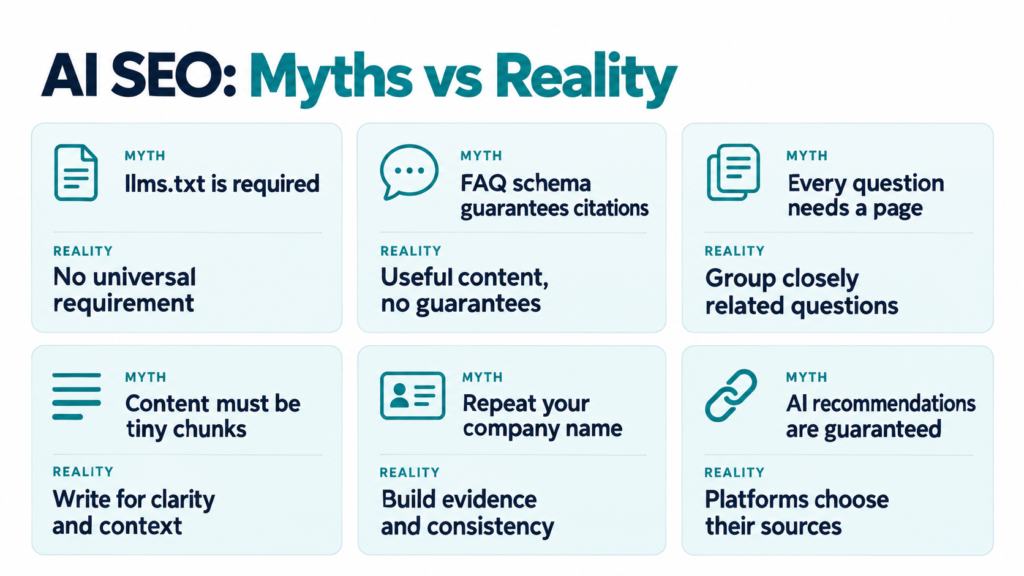
Myth 1: An llms.txt file is required
There is no universal requirement for an llms.txt file.
Google states that it does not require AI text files or special machine-readable files for its AI search features. Its newer guidance says llms.txt neither helps nor harms visibility in Google Search because Google does not use it for that purpose.
Other platforms may use different controls, so crawler requirements should be assessed individually.
Myth 2: FAQ schema guarantees an AI citation
It does not.
FAQs can make a page more useful when they answer genuine customer questions. Structured data can also help describe eligible content.
Neither guarantees that a search or AI platform will cite the page.
Myth 3: Every question needs a separate page
Creating hundreds of pages for slightly different questions usually produces duplication and weak content.
One complete page can answer several closely related questions when they belong to the same user need.
Separate pages should only be created when the intent is meaningfully different.
Myth 4: Content must be written in tiny AI-friendly chunks
Clear headings, short paragraphs and direct answers improve usability, but there is no mandatory content-chunk size.
Do not damage the reading experience by reducing every answer to disconnected fragments.
Myth 5: Repeating the company name improves AI visibility
Repetition does not establish credibility.
Clear service information, consistent business details, real evidence, useful content and relevant external references provide stronger foundations.
Myth 6: AI SEO can guarantee recommendations
No agency controls which sources an AI platform selects.
Promising a guaranteed citation, recommendation or position is no more credible than guaranteeing the first organic result.
What Should a Courier Company Measure?
AI SEO should not be judged only by screenshots of the company appearing in an answer.
Visibility can change between:
- Platforms
- Users
- Locations
- Devices
- Prompt wording
- Search sessions
- Dates
Measurement should combine several signals.
| Measurement area | What to review |
|---|---|
| Technical access | Crawlability, indexation and blocked resources |
| Search visibility | Relevant impressions, clicks and landing pages |
| AI visibility | Observable citations and source appearances where available |
| Referral activity | Identifiable visits from AI-assisted platforms |
| Local visibility | Business Profile and Maps activity |
| Engagement | Useful page interaction and quote-page visits |
| Enquiries | Calls, forms and quote requests |
| Enquiry quality | Whether the request matches real services and coverage |
| Commercial outcomes | Booked work where reliable attribution exists |
Google reports activity from its AI search features through Search Console reporting, although the exact level of available detail may change.
Some AI referral traffic can also be identified through analytics. Other visibility may be difficult to attribute accurately.
Reporting should distinguish between:
- Confirmed data
- Observable evidence
- Reasonable estimates
- Information that cannot currently be verified
An AI citation is not automatically a lead. A website visit is not automatically a booking.
The more useful journey is:
Discovery → relevant visit → call or quote request → qualified enquiry → booked courier work
A Practical AI SEO Checklist for Courier Companies
Technical access
- Important pages can be crawled.
- Commercial pages are indexable.
- Robots.txt rules have been reviewed.
- Platform-specific crawler controls are understood.
- Mobile pages display important information correctly.
- Internal links lead to live destinations.
- Canonical URLs and redirects are correct.
- XML sitemaps contain the required pages.
Business clarity
- The genuine company name is used consistently.
- Services are clearly described.
- Service areas reflect real operations.
- Contact information is accurate.
- Availability claims are supportable.
- The quote and booking process is explained.
- Business Profile information agrees with the website.
Content quality
- Each page has one primary purpose.
- Direct answers include necessary context.
- Content contains original operational information.
- Important facts appear in visible page text.
- Claims are supported by genuine evidence.
- AI-assisted content receives expert human review.
- Duplicate and near-duplicate pages are avoided.
- Existing content is reviewed and updated.
Structured information
- Appropriate structured data has been considered.
- Markup matches visible information.
- False reviews and unsupported properties are absent.
- Structured data has been validated.
- No special schema is being treated as an AI guarantee.
Authority and measurement
- Important pages receive relevant internal links.
- External mentions have a genuine business reason.
- Search Console and analytics are configured.
- Calls and quote forms are tracked where possible.
- Qualified enquiries are reviewed.
- AI citations are not presented as confirmed leads.
- Reports separate facts from estimates.
Build for Customers First
AI SEO is not a secret replacement for ordinary SEO.
For UK courier and delivery businesses, the strongest approach is to publish accurate service information, maintain a technically accessible website, explain genuine coverage, answer customer questions and support important claims with real evidence.
The website should be useful even if no AI system ever cites it.
That is the correct standard because search platforms will continue changing. Clear business information and a reliable enquiry journey remain valuable regardless of how the answer is presented.
Insight Crafts Marketing connects technical SEO, content, local visibility, business information and AI-search readiness into one courier-focused system.
Learn more about AI Search Optimisation for Courier Companies or request a Courier SEO Audit.