A courier company can have a complete Google Business Profile and still struggle to appear prominently across Birmingham.
That is because Google Maps visibility is not controlled by one setting, one keyword or the number of Birmingham areas added to a profile. Google says local results are mainly determined by relevance, distance and prominence. For courier businesses, those factors need to work together with genuine service coverage, accurate business information, a relevant website and a clear customer journey. (Google Help)
That distinction matters in Birmingham because courier searches can be highly specific. Current search results include demand around same-day delivery, urgent collections, documents, parcels, pallets and business courier work rather than one generic “courier” requirement. (Uber)
So the goal is not simply to “optimise Google Maps”.
The goal is to make it easier for Google and customers to understand what the courier actually does, where it genuinely operates and why it is a relevant result for a particular search.
What Actually Determines Google Maps Rankings?
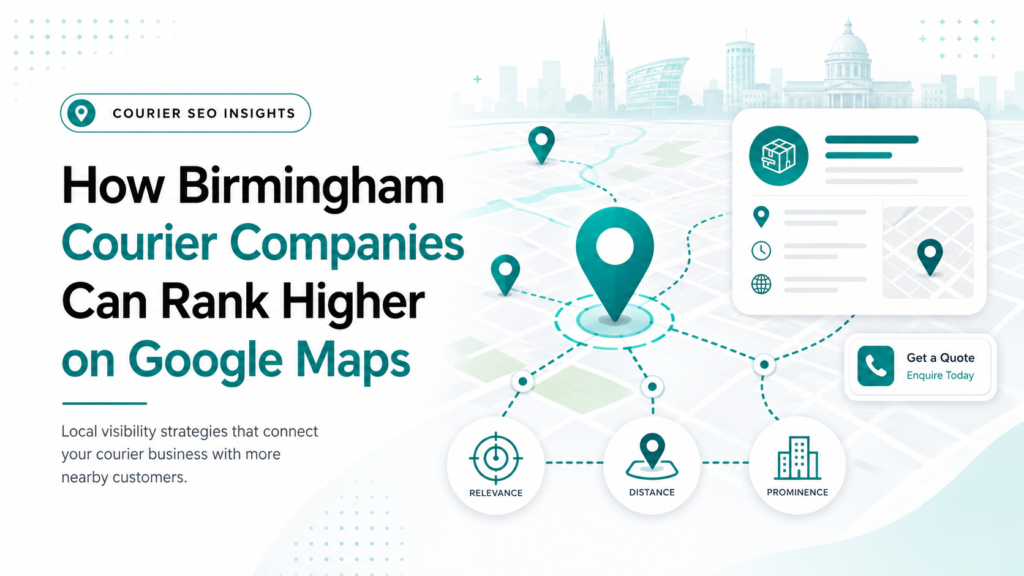
Google describes three main factors behind local rankings: relevance, distance and prominence.
| Factor | What it means | What a courier company can influence |
|---|---|---|
| Relevance | How closely the business matches what the customer is searching for. | Accurate category, services, profile information, website content and clear service pages. |
| Distance | How far the business is from the searcher or location used in the search. | Very limited control; the genuine business location still matters. |
| Prominence | How established or well known the business appears. | Reviews, links, mentions, reputation and wider online authority. |
Why this matters: copying an optimisation checklist from another courier company is not enough. Each business is evaluated against its own relevance, location and prominence in relation to the search being made.
This explains why copying an optimisation checklist from another courier company is not enough.
A courier may be highly relevant for an urgent collection search but geographically weaker for a customer at the other side of Birmingham. Another operator may be closer but have weaker service relevance or prominence.
There is no profile field that removes this trade-off, and Google explicitly states that businesses cannot request or pay for a better organic local ranking.
That is the first principle to understand before changing anything.
Why Google Maps SEO Is Different for Courier Companies
Courier companies often operate differently from businesses such as restaurants, shops or dentists.
Customers normally do not need to visit the courier’s premises. The courier collects from the customer, delivers to a destination or supports a business through scheduled or time-critical movements.
That can make the company a service-area business rather than a conventional storefront.
Google defines service-area businesses as businesses that visit or deliver directly to customers rather than serving them at a customer-facing business address. If customers are not served at the address, the address should not be displayed as though they can visit it.
This creates an important difference between:
where a courier genuinely provides services
and
where Google considers that business to be located for local-search purposes.
The two are not interchangeable.
A courier may genuinely collect from customers across Birmingham, Solihull and parts of the Black Country. That does not mean it should manufacture a branch in each area or expect one Business Profile to have equal Maps visibility everywhere.
Understanding this prevents many of the most damaging local SEO decisions.
Strengthen the Relevance of Your Courier Business Profile
The relevance question is simple:
Does the profile clearly and accurately represent the business a customer is searching for?
Start with the core business rather than keywords.
Google recommends choosing the most specific available primary category that accurately describes the business, then using only relevant additional categories. It specifically advises businesses not to add a separate category for every product or service.
That principle is particularly useful for courier companies.
Same-day delivery, document delivery, pallet movements or scheduled business work may all be genuine services, but they should not be turned into unrelated categories simply because those phrases have commercial value.
Services can instead be added within the Business Profile where appropriate. Google allows businesses to add available or custom services and provide details about them.
The profile should also agree with the website.
If the Business Profile suggests that the company provides urgent same-day courier work but the website only talks vaguely about “delivery solutions”, the customer journey becomes less clear.
Equally, the website should not promote specialist services the courier does not genuinely provide simply to expand search coverage.
This is where [local SEO for courier companies] needs to connect profile relevance with real website content rather than treating the Business Profile as an isolated asset.
Do Not Confuse Birmingham Service Areas With Birmingham-Wide Rankings
This is one of the most important points for a courier company.
Adding Birmingham as a service area does not guarantee visibility throughout Birmingham.
Google allows service-area and hybrid businesses to specify genuine areas they serve. A profile can currently include up to 20 service areas, and Google recommends keeping the overall service territory reasonably connected to the actual business base.
The purpose of those settings is to describe where the company serves customers.
They do not remove the distance component from Google’s local-ranking system.
So if a courier adds Birmingham, Solihull, Wolverhampton and numerous other areas to the profile, that does not automatically create strong Maps visibility in each location.
This distinction is easy to miss:
Where the business says it genuinely operates and serves customers.
Google's decision about which businesses are most relevant to a particular search in a particular location.
They are connected, but they are not the same thing. A service area should therefore reflect genuine operating coverage rather than being maximised simply to target more locations.
Do Not Create Fake Birmingham Locations to Chase Maps Visibility
Distance can make local SEO frustrating, especially for a courier serving a wide operating area.
The wrong response is to create artificial locations.
Google’s Business Profile guidelines state that service-area businesses should generally have one profile for their central office or location. A virtual office is not eligible simply because a business wants visibility in another area, and separate service locations need to represent genuine operating locations that meet Google’s requirements.
Google also says a business should normally have only one profile for each business. Multiple profiles for the same business can be treated as duplicates and may not appear in Search or Maps.
For a Birmingham courier company, that means avoiding tactics such as rented mailboxes presented as branches, unstaffed virtual offices, duplicate profiles for different courier services or fabricated town locations.
A genuine service-area business does not need to pretend it has twenty depots.
Its website can explain wider operating coverage while its Business Profile accurately represents the real business.
Connect Google Maps Visibility With the Courier Website
A Google Business Profile cannot carry the entire search strategy.
The profile is useful for quick business information: what the company does, when it operates, where it serves, how to call and how to reach the website.
The website has a different job.
It can explain the services in enough detail for a customer to decide whether the courier fits the job.
For example, someone searching for an urgent document collection may need to understand availability, collection process and how to request a quote. A business considering regular delivery support may care more about operating coverage, service types and ongoing communication.
Current Birmingham courier search results reflect this variation. Strong courier pages commonly make distinct propositions around same-day delivery, urgent work, documents, pallets, scheduled services and business delivery.
That does not mean every courier needs a page for every phrase.
It means the website should give important services a clear destination when they represent a genuine customer need.
For the wider architecture behind service pages, Birmingham location intent and supporting content, see [how to improve your courier company’s wider Google visibility in Birmingham].
The Business Profile and website should ultimately describe the same real courier business from different levels of detail.
Build Birmingham Relevance Without Stuffing Birmingham Everywhere
Local relevance does not come from repeating Birmingham in every heading, service description and paragraph.
Nor does a list of dozens of postcodes prove that a courier has meaningful local expertise.
Use Birmingham context where it helps the customer understand something real:
whether the company collects from the area, which services are available, what operating limitations apply, how urgent work is handled and where wider regional coverage begins.
A reference to a business district, road or neighbouring area should therefore have a reason to exist.
The same rule applies to location pages.
A Birmingham commercial page can own Birmingham-specific courier SEO service intent, while supporting articles like this one answer narrower informational questions. Your existing pillar already establishes that separation between commercial location pages and supporting cluster content. (Insight Crafts Marketing)
This protects the site from creating several URLs that all try to answer the same question.
Reviews Can Strengthen Both Prominence and Customer Confidence
Reviews serve two different purposes.
They help potential customers judge whether the courier appears dependable, and they can contribute to the prominence side of local search.
Google states that more reviews and positive ratings can help a business’s local ranking and recommends responding to customer reviews.
But there is no sensible universal target such as:
“Get 50 reviews and you will reach the Map Pack.”
Competition, distance, relevance and wider prominence still matter.
The safer approach is to build a consistent process for requesting genuine customer feedback after real work and responding professionally.
For a courier business, useful reviews may naturally mention the experience the customer actually had—such as communication, collection, reliability or handling of an urgent job—without the business scripting keyword-heavy testimonials.
Do not buy reviews, manufacture them or pressure customers into predetermined wording.
A review strategy should create credible evidence, not artificial optimisation signals.
Why Your Courier May Rank in One Part of Birmingham but Not Another
A Maps ranking is not one fixed number.
That is one of the biggest misconceptions in local SEO.
Because distance is part of Google’s local-ranking system, the same courier can appear differently when searches take place from different parts of Birmingham.
Imagine a courier genuinely serving the whole city.
Its profile may perform relatively well near the company’s actual base. The same business may become less visible when the search is made much farther away, particularly when strong competitors are physically closer to the searcher.
That does not automatically mean the profile has been “penalised”.
It may simply reflect the local nature of the result.
This is why checking one search from one device is a weak way to judge Maps performance.
A more useful review looks at geographic visibility patterns alongside the searches being targeted, competitor locations, profile relevance and actual enquiries.
The diagnostic question becomes:
Where does visibility weaken, for which service searches, and what explains the pattern?
That is much more useful than asking whether the company “ranks number three in Birmingham”.
Use Real Business Photos, Not Fake Local Proof
Photos should help a potential customer understand and trust the real operation.
Google recommends business-specific imagery that accurately represents the business and states that photos should be clear, properly lit and not significantly altered in ways that stop them representing reality.
For a courier company, useful imagery could show genuine vehicles, staff, operational activity or real premises where appropriate.
A Birmingham landmark placed behind a stock van does not prove the company operates there.
Neither does adding fake map pins to promotional graphics.
The principle is the same throughout the article:
show the real business more clearly instead of manufacturing localisation.
Common Google Maps Mistakes to Diagnose
Many local visibility problems come from trying to expand reach before the underlying business information, profile setup and website journey are accurate.
| Mistake | Why it creates a problem | Better approach |
|---|---|---|
| Adding keywords to the business name | Google requires the profile name to reflect the real-world business name. | Use the genuine trading name. |
| Creating profiles for every service | Separate profiles should not be created merely because one business offers different services. | Keep one eligible business profile and describe genuine services. |
| Adding every nearby town as a ranking tactic | Service areas describe genuine coverage; they do not guarantee stronger local visibility. | Use accurate operating areas. |
| Creating virtual Birmingham offices | Virtual offices generally do not qualify as genuine customer-facing business locations. | Represent the real operating model. |
| Treating reviews as a numbers race | Review quantity alone cannot override relevance, distance and competition. | Build genuine feedback consistently. |
| Measuring one Maps position | Local visibility can change depending on where the search takes place. | Review geographic patterns and enquiries. |
| Optimising the profile but ignoring the website | Customers still need detailed service information and a working route to call or request a quote. | Align GBP, service pages and location content. |
Accuracy comes first: Google's profile guidelines require businesses to use their real-world business name, genuine locations and accurate information. Unnecessary keywords should not be added to the business name simply to influence search visibility.
Measure Google Maps Performance Beyond Rankings
A courier company ultimately needs enquiries, not screenshots of ranking positions.
Google’s Business Profile performance reporting can provide information about views, clicks and other customer interactions with the profile on Search and Maps.
Where available and properly configured, that can include interactions such as website clicks, calls and directions. Google now also supports sharing certain Business Profile performance information with Google Analytics.
But the measurement should continue beyond the profile.
A useful reporting chain is:
Maps visibility → profile interaction → website or call → completed enquiry → qualified courier opportunity.
This prevents three common reporting mistakes.
A profile view is not a lead.
A website click is not a lead.
A button click is not necessarily a completed quote request.
If possible, the business should understand which search journeys produce genuine calls, completed forms and useful commercial enquiries.
That makes Maps work accountable to the business rather than to a ranking report.
A Practical Birmingham Courier Maps Diagnostic
Before adding more content or changing the profile repeatedly, diagnose the weakest layer first.
| What you observe | What to investigate first |
|---|---|
| Business appears for its name but rarely for courier-service searches. | Category, services, website relevance and service-page clarity. |
| Visibility is strong near the base but falls farther across Birmingham. | Distance and competitor geography. |
| Profile is accurate but stronger competitors dominate. | Reviews, authority, links, mentions and broader prominence. |
| Maps generates views but few calls or enquiries. | Profile proposition, contact route and customer journey. |
| Website and profile describe different services or areas. | Business information and page alignment. |
| Several duplicate or town profiles exist. | Eligibility, duplication and Business Profile policy compliance. |
| Traffic arrives but cannot be connected to leads. | Call, form and quote-request tracking. |
This is the point at which optimisation becomes strategic.
Do not fix every field because a checklist tells you to. Fix the signal that is actually limiting visibility or conversion.
Diagnose before optimising: identify whether the real constraint is relevance, distance, prominence, conversion or measurement before changing the profile, producing more content or creating additional pages.
Build Stronger Local Visibility Without Fake Shortcuts
A Birmingham courier company does not need more location names, fake offices or guaranteed-ranking promises.
It needs a Business Profile that accurately represents the operation, a website that explains real services and coverage, genuine customer proof and reliable measurement of the journey from Maps visibility to enquiry.
Insight Crafts Marketing can review where that journey is breaking and identify whether the next priority is profile relevance, local coverage, website structure, prominence or enquiry tracking.
Request a Courier SEO Audit →